
Table of Contents
Introduction
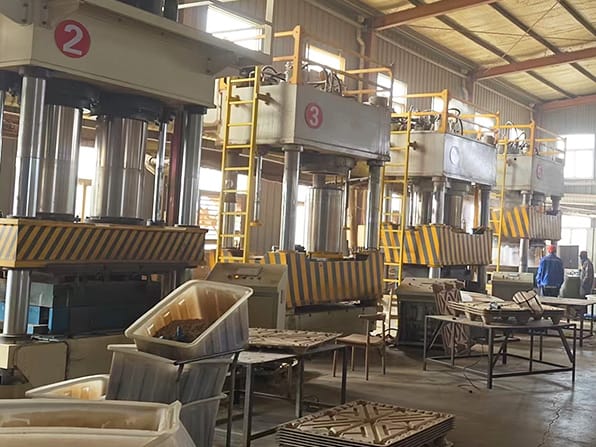
Choosing between different pallet types is not simply a question of wood, plastic, or another material. Pallets can also differ in deck structure, lower support design, fork-entry configuration, manufacturing method, dimensions, nesting ability, and the way they behave under floor storage, forklift handling, stacking, or racking.
These differences matter because the pallet is part of the complete material-handling system. A design that works well for evenly distributed cartons may not provide the same support for machinery or bulk loads. A pallet intended mainly for floor storage may require additional evaluation before it is placed across rack beams, while a design used with forklifts may not automatically suit conveyors or automated equipment.
The basic pallet concept provides a platform for consolidating goods into manageable unit loads, but industrial users need to look beyond that simple definition. Selecting appropriate pallet types requires an understanding of the cargo, warehouse equipment, storage method, load distribution, and expected handling cycle.
Key points covered in this guide include:
- major pallet types by structure and material
- single-deck and double-deck pallet differences
- two-way and four-way entry configurations
- traditional wood and molded wood pallet designs
- pallet types for heavy and concentrated loads
- warehouse, rack, conveyor, and automated applications
- dimensions and empty-storage considerations
- how to match pallet design to actual operating conditions
Why Are There So Many Pallet Types?
Pallets perform the same basic function, but they are used under very different conditions.
One warehouse may handle lightweight packaged goods that remain on a floor for short periods. Another operation may move dense industrial components repeatedly between production, storage, and shipping areas. Some pallets need to fit racks, while others are designed mainly for floor stacking or forklift movement.
These differences have led to multiple structural approaches.
Pallet types can be classified according to material, deck configuration, support structure, fork-entry direction, or intended application. In practice, several classifications often apply to the same pallet.
For example, one product might simultaneously be described as a molded wood pallet, single-deck pallet, four-way entry pallet, and nestable pallet.
This is why comparing pallet types only by one feature can be misleading. A useful comparison should consider the complete structure and how it interacts with the load.
Single-Deck Pallets
Single-deck pallets use one primary upper deck to support the cargo, with legs, runners, blocks, or other structures underneath.
This configuration can be useful where relatively low pallet weight, straightforward handling, or efficient empty storage is important.
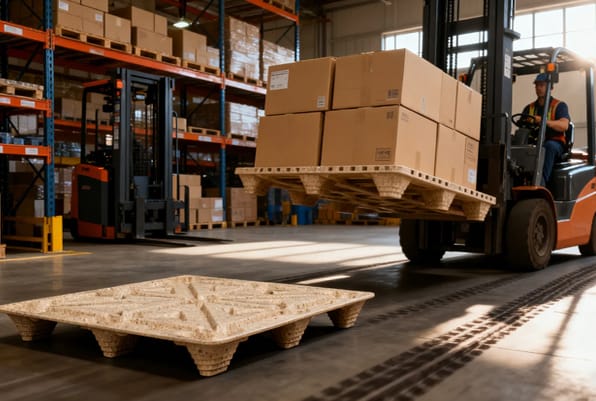
Some molded single-deck pallet types can also nest. Supporting legs fit partially into corresponding areas of another empty pallet, reducing the total height of a stack.
The absence of a full lower deck does not automatically make a single-deck pallet suitable only for light loads. Performance depends on deck geometry, supporting structures, material distribution, and the way the load is positioned.
For industrial applications, the main questions are whether the deck provides sufficient support beneath the cargo and whether the lower geometry works with the intended forklift, floor, conveyor, or storage system.
Double-Deck Pallets
Double-deck pallets add lower structural elements beneath the primary loading deck.
Depending on the design, the lower structure can increase stability, alter load transfer, or provide a different interface with floors, handling equipment, and other pallets.
These pallet types can be useful when industrial loads require more structured lower support. However, their actual suitability still depends on factors such as cargo weight, support locations, forklift openings, and storage method.
Xinyi’s double-deck square-grid pallet series uses molded upper and lower structural geometry designed for industrial handling, warehousing, and logistics applications.
A double-deck configuration should not be selected simply because it appears more substantial. The lower deck needs to perform a useful structural function within the intended logistics environment.
Two-Way and Four-Way Entry Pallet Types
Fork-entry configuration affects how warehouse operators approach and move palletized loads.
Two-way entry pallets allow forklift access from two opposing directions. This can work efficiently when pallet orientation remains controlled and warehouse movement follows predictable routes.
Four-way entry pallets provide access from multiple sides. This can improve handling flexibility in staging areas, production facilities, busy warehouses, and locations where operators frequently reposition loads.
The number of entry directions should not be treated as a simple quality ranking. A four-way pallet is not automatically better for every application.
Entry openings still need adequate height, width, and spacing. Supporting legs, runners, or molded structures should also avoid interfering with normal fork positions.
In repetitive warehouse operations, practical clearance is particularly important because repeated contact between forklift blades and pallet structures can contribute to unnecessary wear.
Traditional Wood Pallets
Traditional wood pallets remain one of the most familiar pallet types in logistics.
They are generally assembled from individual boards, blocks, runners, and fasteners. This construction method allows many dimensions and structural configurations to be produced.
Their performance can be influenced by lumber characteristics, moisture condition, board thickness, joint design, runner spacing, fastener placement, and manufacturing consistency.
Because traditional wood is a natural material, individual components may vary. Production control therefore plays an important role in maintaining repeatable pallet dimensions and structural quality.
Traditional wood pallets can work effectively in many industrial applications when their structure is properly matched to cargo and handling conditions.
Molded Wood Pallets
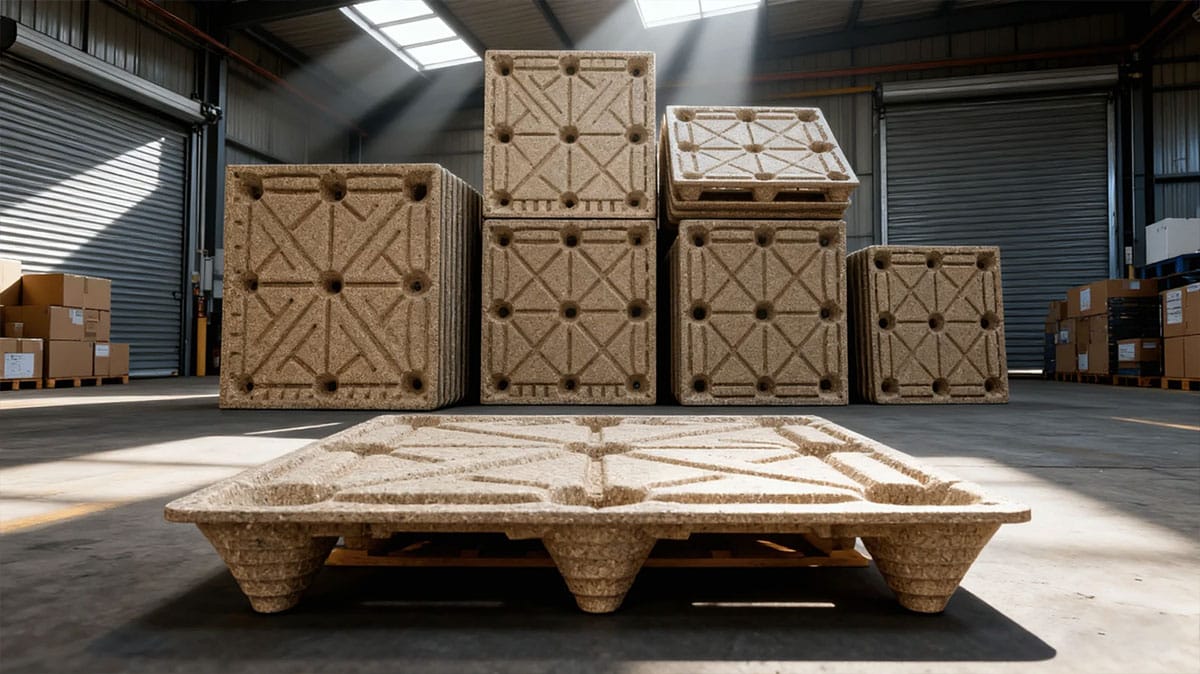
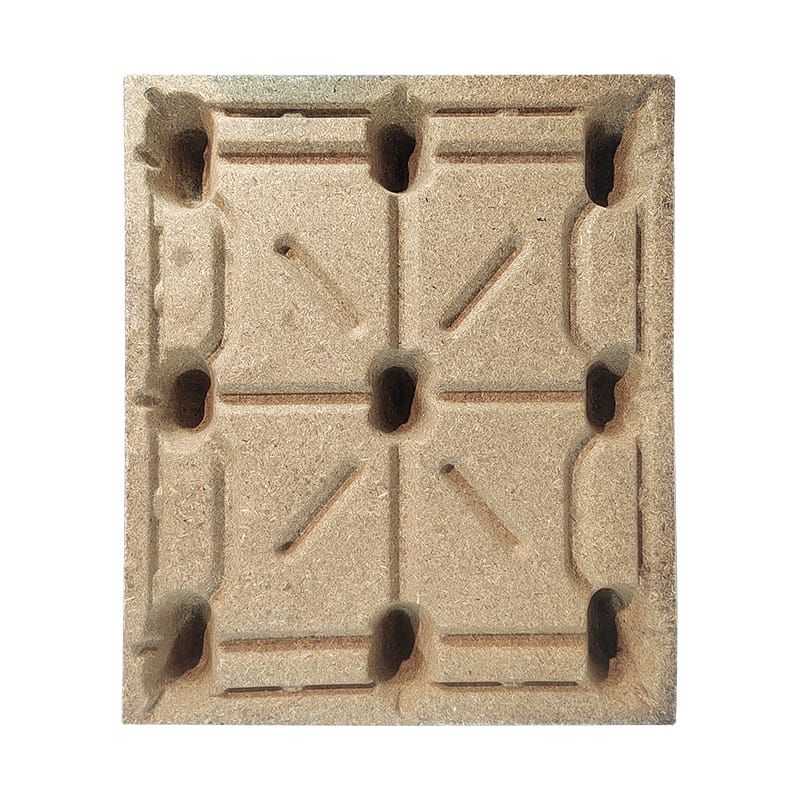
Molded wood pallet types use processed wood or plant-fiber materials formed into a defined structural shape.
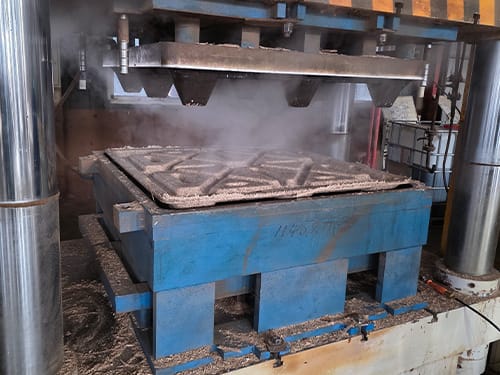
Instead of assembling the finished pallet primarily from separate boards and mechanical fasteners, molding can integrate the deck, ribs, supporting legs, grids, and other structural features.
This manufacturing approach makes structural geometry an important part of the pallet design.
Reinforcement can be positioned around load-bearing areas, while leg structures and fork openings can be incorporated directly into the formed pallet.
Molded pallet designs can also support nesting where the geometry allows one empty pallet to fit partially into another.
The broader Xinyi guide to different types of pallets provides additional context for comparing molded structures used across warehouse and industrial applications.
As with every pallet material, the word “molded” alone does not determine suitability. Load distribution, dimensions, support conditions, and handling equipment still need to be evaluated.
How Major Pallet Types Compare
Different pallet configurations offer different characteristics rather than a single ranking from best to worst.
| Pallet Type | Main Structural Characteristic | Useful Application Consideration | Key Factor to Check |
|---|---|---|---|
| Single-deck pallet | One primary upper deck | Efficient handling and empty storage | Lower support geometry |
| Double-deck pallet | Additional lower structure | Industrial stability and load transfer | Handling and storage support |
| Two-way entry pallet | Fork access from two directions | Controlled warehouse movement | Pallet orientation |
| Four-way entry pallet | Multi-directional fork access | Flexible material handling | Entry clearance |
| Traditional wood pallet | Assembled boards and supports | Wide structural flexibility | Material and assembly consistency |
| Molded wood pallet | Integrated formed geometry | Repeatable structure and potential nesting | Load and support compatibility |
| Nestable pallet | Empty units fit partially together | Reduced empty-storage volume | Loaded structural requirements |
| Stackable pallet | Empty pallets remain vertically aligned | Predictable pallet storage | Stack stability |
| Heavy-duty pallet | Structure designed for demanding loads | Machinery or industrial cargo | Actual load distribution |
The table shows why pallet types should be evaluated according to application rather than terminology alone.
A pallet may belong to several categories simultaneously.
Nestable and Stackable Pallets

Empty pallet storage can become an important warehouse issue when large quantities of pallets accumulate between handling cycles.
Stackable pallets sit directly on top of one another. Their individual height largely determines how much vertical space a stack requires.
Nestable pallet types use a different geometry. Parts of one pallet fit into open areas of the pallet below, reducing the height added by each additional empty unit.
This can be useful in warehouses, staging areas, and manufacturing facilities where empty-pallet space is limited.
However, empty storage should not become the primary selection criterion. A highly nestable design provides limited value if the loaded pallet does not adequately support the intended cargo.
The best approach is to confirm loaded performance first and then optimize empty handling where possible.
Pallet Types for Heavy Industrial Loads
Heavy cargo does not automatically require the largest or heaviest pallet.
Load distribution often matters as much as total weight.
An evenly distributed load places pressure across a relatively large deck area. Machinery supported by several narrow feet can concentrate the same overall weight into a much smaller area.
For concentrated loads, the most suitable pallet types are those with appropriate structural support beneath the actual contact points.
This may involve reinforced deck areas, ribs, grids, runners, or supporting legs positioned where the product transfers its weight.
The center of gravity should also be considered. Tall or uneven industrial loads can become more difficult to control during forklift movement even when the pallet remains structurally adequate.
When selecting pallets for heavy products, provide the manufacturer with information about product dimensions, total loaded weight, contact locations, and expected handling conditions rather than asking only for a high-capacity pallet.
Pallet Types for Warehouse Floor Storage
Floor storage generally provides broad support beneath the pallet.
For this reason, many pallet types can perform effectively on stable warehouse floors when their static load requirements are appropriate.
However, floor storage should still consider product footprint, stacking, forklift entry, and available space.
If pallets are block-stacked, the lower loaded units may also support the weight of pallets above them. Load alignment and packaging strength then become part of the storage system.
A pallet that performs well under a single floor-supported load may therefore need additional evaluation when several loaded units are stacked vertically.
Warehouse operations should distinguish between simple floor storage and more demanding stacking conditions.
Pallet Types for Rack Storage
Rack storage changes how a pallet is supported.
Instead of receiving broad support from the floor, the pallet may rest mainly across selected rack beams. Parts of the structure between those beams can remain unsupported.
This makes pallet stiffness and geometry particularly important.
When comparing pallet types for rack use, consider beam spacing, pallet orientation, load distribution, storage duration, and unit-load weight.
A pallet that physically fits the rack opening is not automatically suitable for the structural support condition.
Static floor capacity should also not be assumed to represent rack performance. The two conditions place different stresses on the pallet.
For demanding racking applications, pallet structure and rack configuration should be evaluated together.
Pallet Types for Conveyors
Conveyor systems place additional importance on the bottom of the pallet.
Rollers, chains, or other conveying components need appropriate contact with the lower pallet structure.
Leg positions, runners, grid geometry, and direction of travel can all influence movement through the conveyor.
A pallet designed primarily for forklift use may therefore require further evaluation before being introduced into a conveyor system.
Dimensional consistency becomes important as well. If pallet length, width, height, or supporting geometry varies significantly, conveyor movement can become less predictable.
Facilities using both forklifts and conveyors should specify both handling methods when choosing pallet types.
Pallet Types for Automated Warehouses
Automated storage and retrieval systems generally require greater dimensional repeatability than manual handling.
A human forklift operator can compensate for small differences in pallet position or geometry. Automated equipment typically expects pallet dimensions and contact areas to remain within defined operating limits.
For this reason, suitable pallet types for automation should provide consistent external dimensions, fork openings, lower structures, and orientation.
Manufacturing repeatability becomes a practical part of pallet performance.
Molded structures can offer repeatable geometry when material preparation, molding conditions, and quality control are maintained consistently. Traditional assembled pallets can also work with automated systems when component dimensions and assembly are suitably controlled.
The important factor is not the material category alone, but whether the finished pallet can consistently meet the requirements of the equipment.
How Pallet Dimensions Affect the Best Type
Pallet type and pallet dimensions should not be selected independently.
A single-deck pallet that works well at one footprint may require a different structural design when dimensions increase. Longer spans can change how the deck bends or how forces reach supporting legs.
Product fit also matters.
A pallet that is too small can allow cargo to overhang the deck, leaving product edges unsupported and more exposed to impact.
An unnecessarily large pallet wastes deck area and can reduce warehouse or transport-space efficiency.
The ideal dimensions support the final packaged product while fitting forklifts, racks, conveyors, staging areas, and storage positions.
For industrial products with unusual footprints, an application-specific size may be more useful than forcing the load onto a familiar standard dimension.
How Pallet Types Affect Load Capacity
No pallet category has one universal load capacity.
Capacity depends on material, structural geometry, dimensions, load distribution, and support conditions.
Static loading usually refers to a pallet resting on a sufficiently supportive surface. Dynamic loading becomes relevant when forklifts lift and move the pallet. Rack storage can create different bending conditions because support may be limited to certain areas.
A pallet may therefore have different practical capabilities under each condition.
When comparing pallet types, always ask which support condition applies to the stated capacity.
The most technically useful specification describes both the load and how the pallet is supported during testing or use.
This is especially important for machinery, bulk goods, containers, and other concentrated industrial loads.
Choosing Pallet Types for Shipping and Logistics
Pallets used throughout a broader logistics cycle may experience more varied conditions than pallets used only inside one controlled warehouse.
Repeated loading and unloading, forklift transfers, storage, stacking, vibration, and changing environments all influence pallet requirements.
The appropriate pallet type should therefore remain suitable throughout the expected handling cycle.
Material characteristics can matter, but the complete pallet structure deserves equal attention. Fork-entry geometry, cargo support, manufacturing consistency, pallet dimensions, and tare weight all influence practical logistics performance.
For recurring shipments, consistent loading patterns are also valuable. Placing the product in the same position on the same pallet design helps make load behavior more predictable.
Material Should Not Be the Only Selection Factor
It is common to begin pallet selection with questions such as “wood or plastic?” or “traditional wood or molded wood?”
Those comparisons can be useful, but they come too early if the application has not yet been defined.
A better process begins with the cargo and operating conditions.
Determine the loaded weight, product footprint, contact points, handling equipment, storage method, and expected movement before comparing materials.
Once these requirements are understood, the advantages and limitations of individual pallet types become much easier to evaluate.
A well-designed molded wood pallet can outperform a poorly matched traditional pallet in one application, while the opposite may be true in another.
There is no universal material winner because the pallet is a structural system rather than simply a piece of material.
Manufacturing Quality Can Change Pallet Performance
Even the correct pallet type can create problems if manufacturing consistency is poor.
Traditional wood pallets depend on suitable component dimensions, lumber condition, joints, fasteners, and assembly.
Molded pallet production depends on raw material preparation, material distribution, forming conditions, mold geometry, and dimensional control.
Important finished characteristics may include overall dimensions, pallet height, fork openings, leg positions, structural geometry, and surface condition.
Manufacturing consistency becomes especially important in automated warehouses and conveyor systems.
A specification therefore needs to consider both the design and the ability of the manufacturer to reproduce that design consistently.
When Should You Consider a Custom Pallet Type?
Standard pallet types work effectively when they already fit the product and equipment.
Customization becomes useful when an existing configuration creates a recurring operational problem.
Machinery may require reinforcement beneath specific contact points. Large industrial components may need a different deck footprint. Conveyors may require specialized bottom geometry, while automated systems may depend on particular dimensions.
Customization can include external dimensions, deck structure, reinforcing ribs, support locations, fork openings, or lower pallet geometry.
The objective should be practical improvement.
A custom pallet should provide better product support, warehouse compatibility, handling efficiency, or structural performance than the available standard options.
Common Mistakes When Comparing Pallet Types
A frequent mistake is assuming that one pallet type is universally stronger or more advanced than another.
Single-deck and double-deck structures solve different problems. Two-way and four-way entry designs suit different workflows. Traditional and molded wood pallets use different manufacturing approaches.
Another mistake is selecting by material without understanding the load. Concentrated cargo may require structural reinforcement regardless of the material category.
A high load rating can also be misleading when the support condition is unclear. Floor, forklift, and rack loading should be considered separately.
Dimensions are another common source of problems. A familiar pallet footprint may still create product overhang or unused deck area.
Finally, empty pallet handling is sometimes ignored. Nesting, stacking, pallet height, and tare weight can influence warehouse efficiency even though they do not directly increase loaded capacity.
How to Choose Between Different Pallet Types
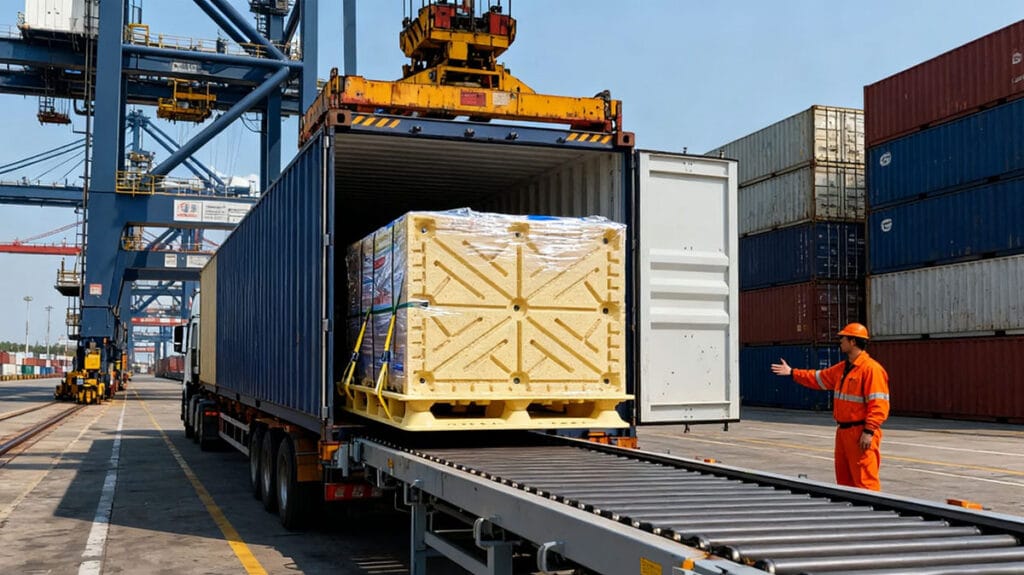
Begin by defining the load. Record its complete weight, packaged dimensions, major contact points, and distribution across the deck.
Next, define where the pallet will be used. Identify whether it will remain on the floor, be stacked, enter racks, travel on conveyors, or interact with automated equipment.
Then review handling requirements. Forklift type, entry direction, opening clearance, and expected handling frequency can influence the structure.
Warehouse and storage requirements should follow. Pallet dimensions need to fit available storage positions without creating excessive unused space or product overhang.
Only after these conditions are understood should the final pallet material and structural type be selected.
This approach makes pallet selection application-driven rather than category-driven.
Conclusion
Understanding pallet types is useful because pallets differ in much more than material.
Single-deck and double-deck structures provide different support configurations. Two-way and four-way entry influence handling flexibility. Traditional wood and molded wood pallets use different manufacturing methods, while nestable and stackable designs address different empty-storage requirements.
No one type is automatically best for industrial logistics.
The appropriate pallet depends on cargo weight, load distribution, product dimensions, forklifts, warehouse storage, racks, conveyors, automation, and the expected handling cycle.
Load capacity should also be evaluated according to actual support conditions rather than treated as one universal number.
The most effective way to compare pallet types is therefore to begin with the application. When the cargo and logistics environment are clearly defined, material, structure, dimensions, entry configuration, and manufacturing requirements can be selected with much greater confidence.
FAQ
What are the main pallet types?
Common pallet types include single-deck, double-deck, two-way entry, four-way entry, traditional wood, molded wood, nestable, and stackable pallets. A single pallet can belong to several categories at the same time because structure, material, and handling configuration describe different characteristics.
Which pallet types are best for industrial use?
There is no single best type for every industrial application. The correct pallet depends on load weight, distribution, product footprint, forklift handling, rack storage, conveyors, and automation. The structure should match the actual operating conditions rather than a general pallet category.
What is the difference between single-deck and double-deck pallet types?
Single-deck pallets use one main cargo deck with supporting structures underneath. Double-deck pallets add lower structural elements that can alter stability and load transfer. Suitability depends on cargo, handling equipment, storage conditions, and the support method used during operation.
Are molded wood pallet types suitable for warehouse use?
Molded wood pallets can suit warehouse applications when their dimensions, deck structure, fork-entry configuration, and load performance match the operation. Integrated ribs, legs, and support geometry can also provide repeatable dimensions and allow certain designs to nest efficiently when empty.
How do I choose between different pallet types?
Start with the cargo weight, dimensions, contact points, and load distribution. Then consider floor storage, stacking, rack use, forklifts, conveyors, and automated equipment. Compare pallet types only after these requirements are clear so the final structure fits the complete logistics system.