
Table of Contents
Introduction

A pallet used inside a warehouse and a pallet prepared for a demanding shipping cycle may look almost identical at first glance. Both support goods, allow forklift access, and simplify unit-load handling. The difference appears when you consider what happens after the shipment leaves a controlled storage environment.
A shipping pallet may be lifted several times, moved between different handling systems, stacked with other loads, exposed to vibration for extended periods, and stored under changing environmental conditions. The pallet also has to protect the stability of the cargo when operators at different stages of the logistics process may handle it in different ways.
That makes shipping pallet selection less about choosing a familiar platform and more about matching the pallet to the complete distribution process.
A pallet is generally used as a stable transport structure that allows goods to be lifted and moved by material-handling equipment. In shipping applications, however, dimensions, load distribution, structural rigidity, entry design, pallet weight, material consistency, and storage conditions all influence practical performance.
Understanding these differences helps you choose a shipping pallet that supports both the product and the logistics operation around it.
What Makes a Shipping Pallet Different?
The term “shipping pallet” does not describe one specific material or construction method.
Instead, it describes how the pallet will be used.
A warehouse pallet may remain inside a relatively predictable environment. Operators know the floor conditions, rack configuration, forklift type, aisle layout, and handling procedures. A shipping pallet often enters a much less predictable cycle.
It may experience:
- repeated forklift transfers
- extended loaded storage
- vibration during transportation
- changes in humidity
- stacking pressure
- temporary staging
- different handling equipment
- multiple loading and unloading events
The longer and more complex the distribution cycle becomes, the more important pallet consistency becomes.
Shipping Is a Repeated-Handling Problem
Many pallet failures are not caused by one dramatic event.
Small stresses accumulate.
A fork blade can strike a supporting leg. A load may be placed slightly off-center. A pallet may be lifted from a less favorable direction. Repeated vibration can gradually change the relationship between cargo and packaging.
For this reason, a shipping pallet should not be evaluated only for the moment when the cargo is first placed on it.
It needs to remain functional after repeated handling.
Shipping Pallet vs Warehouse Pallet
The distinction becomes clearer when both applications are compared directly.
| Selection Factor | Shipping Pallet | Warehouse Pallet |
|---|---|---|
| Handling frequency | May pass through multiple handling stages | Often follows a predictable internal route |
| Environment | May experience changing storage and transport conditions | Usually more controlled |
| Load stability | Important throughout transportation | Mainly important during internal handling and storage |
| Pallet weight | Influences the complete shipping unit | Often less critical in closed internal movement |
| Dimensions | Affect cargo support and transport utilization | Usually optimized around racks and warehouse equipment |
| Material requirements | Must suit the full distribution cycle | Can be selected around a known facility |
| Empty pallet efficiency | Can influence staging and logistics volume | Depends on internal storage practices |
| Structural consistency | Important when handling conditions vary | Important, especially with automation |
| Documentation | Often useful for repeat shipments | Usually managed through internal specifications |
Neither type is automatically stronger or better.
The correct pallet is the one designed around its operating conditions.
A pallet performing well in warehouse floor storage may require different structural characteristics when the same load is repeatedly lifted and transported.
Load Distribution Matters More Than Many Buyers Expect
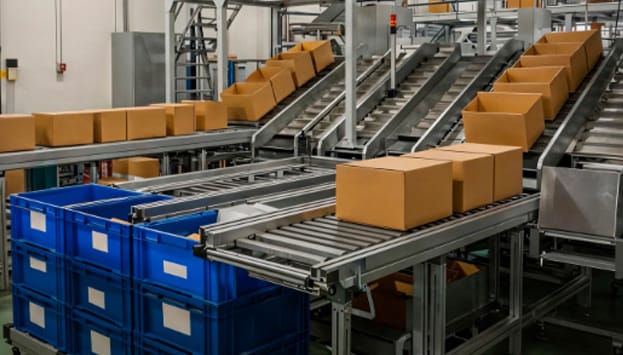
When specifying a shipping pallet, total cargo weight is only the beginning.
You also need to understand how that weight reaches the pallet deck.
Evenly Distributed Cargo
Cartons arranged across most of the pallet surface can spread their weight over a relatively large area.
The pallet structure has more opportunities to transfer that load through different deck areas and supporting elements.
This is generally easier to manage than a load concentrated into a few points.
Concentrated Cargo
Industrial equipment, drums, bulk containers, machinery components, and some large packages can create concentrated loads.
Imagine a heavy machine supported by four narrow feet. Most of its weight may be transferred through four small contact areas rather than across the entire deck.
In that situation, simply increasing the nominal shipping pallet capacity may not solve the problem.
The structure beneath those contact points becomes particularly important.
Reinforcement geometry, deck thickness, rib positions, and lower supports should work with the actual product footprint.
Uneven Loads
Another common challenge is an off-center load.
If most of the product weight is located toward one side of the shipping pallet, forklift handling becomes less predictable. The pallet itself may be strong enough, yet the complete palletized load can become difficult to control.
Before specifying a pallet for an irregular product, identify:
- the heaviest part of the cargo
- its center of gravity
- where the product contacts the deck
- whether the product can shift
- how the load will be restrained
These details often tell you more about pallet requirements than the total weight alone.
Do Not Treat Pallet Capacity as One Number
A shipping pallet does not experience the same support condition throughout its working cycle.
This is why static and dynamic performance should be considered separately.
Static Capacity
Static loading applies when the loaded pallet rests on a sufficiently supportive surface.
A warehouse floor can support much of the lower pallet structure, helping distribute the load.
This is generally a favorable condition.
Dynamic Capacity
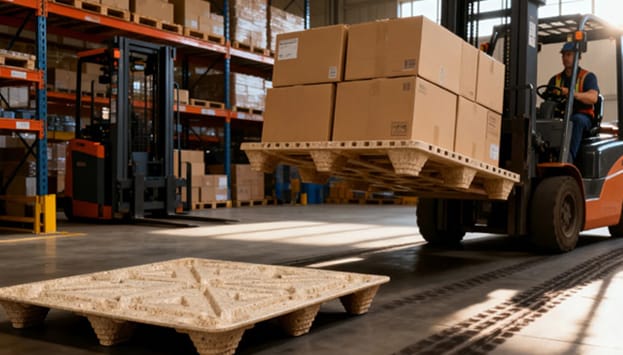
The situation changes when a forklift lifts the pallet.
The floor is no longer supporting the entire base. Forces become concentrated around the areas supported by the forks, while movement introduces additional stresses.
Turning, stopping, vibration, and normal operator handling all influence the loaded pallet.
For a shipping pallet that will be transferred repeatedly, dynamic performance can therefore be more useful than a large static rating viewed in isolation.
Rack Support Is Different Again
If the shipping pallet is stored temporarily or permanently in pallet racking, beam positions can create unsupported spans.
The pallet must resist bending between those supports.
Whenever rack storage is involved, the supplier should know the rack configuration and expected load rather than simply being told that the pallet needs to be “heavy duty.”
How Pallet Structure Affects Shipping Performance
Material matters, but material cannot compensate for poor structural design.
The shipping pallet should distribute loads through its deck, ribs, runners, legs, grids, or other supporting areas without creating unnecessary stress concentrations.
Deck Geometry
A good deck supports the product where support is actually needed.
Products with broad flat bases require different deck characteristics from equipment supported by several narrow feet.
For this reason, pallet design should begin with the cargo footprint.
Lower Support Structure
The underside of the shipping pallet affects:
- forklift handling
- conveyor movement
- stacking
- rack compatibility
- structural rigidity
A double-deck structure, for example, may provide additional lower support for certain industrial applications.
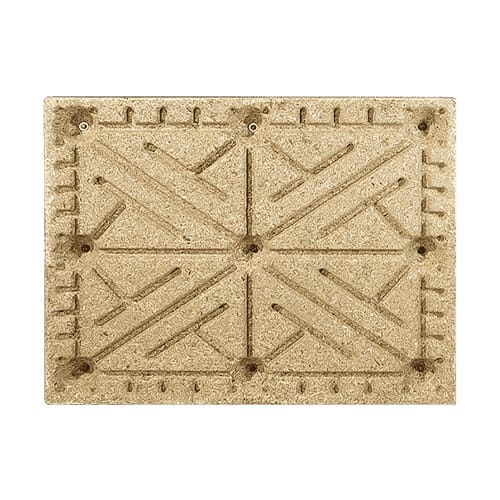
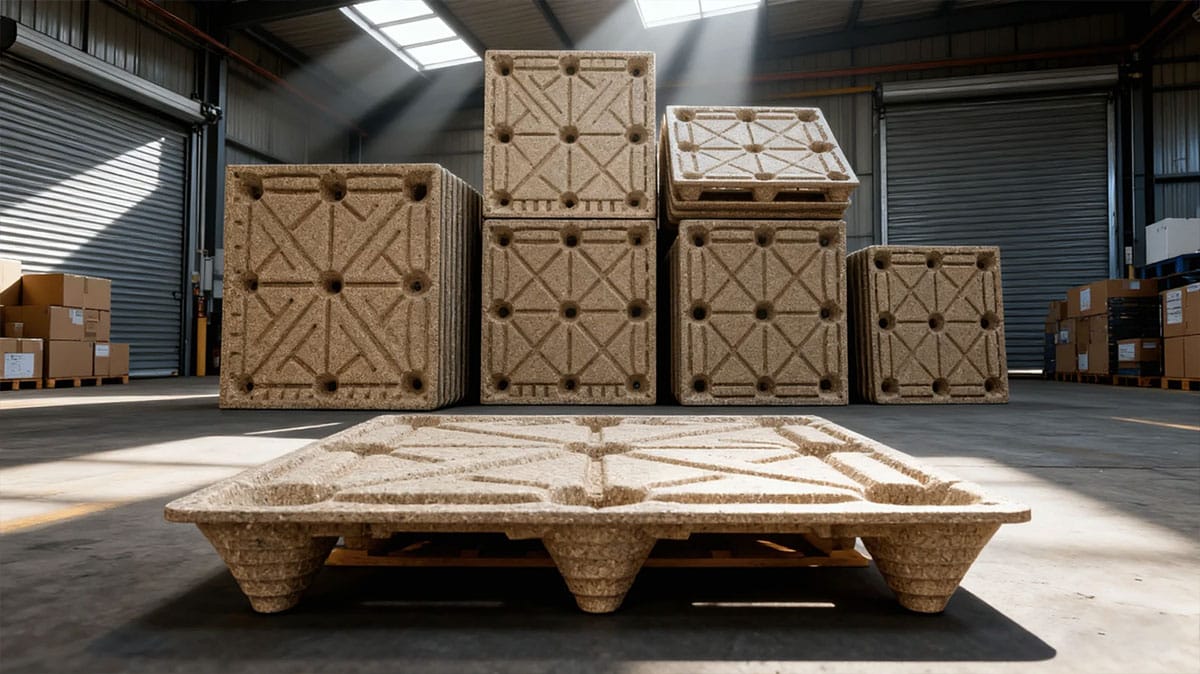
Xinyi’s double-deck square grid pallet range uses molded plant-fiber construction with integrated supporting geometry and is intended for logistics, manufacturing, warehousing, and export-related applications.
Whether that structure is appropriate for a particular shipment still depends on cargo weight, contact points, equipment, and storage conditions.
Fork-Entry Areas
Fork-entry zones deserve special attention because they experience both structural loads and handling impacts.
Adequate clearance reduces the risk of operators repeatedly striking pallet components.
When comparing shipping pallet designs, check:
- entry height
- fork opening width
- supporting-leg positions
- fork spacing
- approach direction
These details can have a direct influence on practical pallet durability.
Which Material Works Best for a Shipping Pallet?
There is no universal answer.
Traditional timber, molded wood fiber, plastic, and other engineered materials can all serve shipping applications when the design matches the requirement.
The more useful question is whether the material and structure remain suitable throughout the intended logistics cycle.
Traditional Wood Shipping Pallets
Traditional wooden pallets can be manufactured in numerous dimensions and configurations.
Their performance depends on more than the fact that they are made from wood. Relevant variables include:
- lumber properties
- moisture condition
- board thickness
- fasteners
- joints
- runner construction
- manufacturing consistency
Where repeated performance is important, these factors need to be controlled.
Molded Wood Shipping Pallets
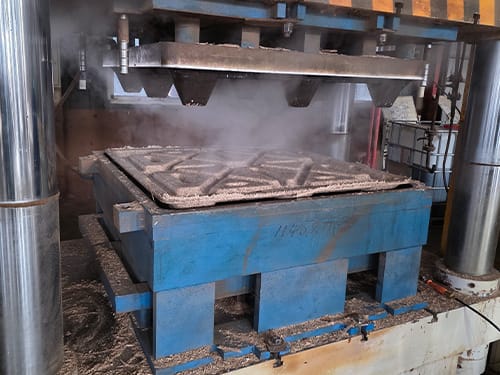
Molded wood pallets use processed wood or plant fibers formed into an integrated structure under heat and pressure.
Instead of assembling separate boards, blocks, and fasteners, the manufacturing process can produce the deck, legs, ribs, and other structural features as part of the molded geometry.
For shipping applications, this can be useful where consistent dimensions, nesting, integrated reinforcement, or processed wood material is desirable.
Xinyi’s existing guide to shipping wood pallets discusses molded wood pallet use in logistics and shipping applications in greater detail.
Plastic and Other Materials
Other materials may be preferred where moisture exposure, cleaning requirements, repeated closed-loop handling, or specialized operating conditions are dominant considerations.
However, comparing materials without comparing structural design can be misleading.
A technically useful comparison should include:
- unit-load requirements
- pallet weight
- dimensional consistency
- handling frequency
- storage conditions
- structural geometry
- end-use environment
Material is one part of the specification, not the specification itself.
Why Shipping Pallet Dimensions Deserve More Attention
A common mistake is to select a familiar pallet dimension before examining the cargo.
This can create either overhang or wasted platform area.
Cargo Overhang
When boxes or products extend beyond the pallet edge, exposed areas become more vulnerable during handling.
Overhang can contribute to:
- package deformation
- edge impact
- unstable stacking
- reduced product support
- contact with neighboring loads
A suitable shipping pallet should provide adequate support beneath the intended cargo footprint.
Excessive Underhang
An oversized pallet creates the opposite problem.
Unused deck space consumes room during storage and transportation without supporting additional cargo.
For high-volume shipping operations, relatively small footprint inefficiencies can become significant when repeated across many palletized loads.
Do Not Choose Size in Isolation
Pallet dimensions should also account for:
- forklift access
- warehouse aisles
- rack dimensions
- product arrangement
- stacking pattern
- handling clearances
- transport-space utilization
The best shipping pallet size is therefore the size that works efficiently with both the product and the surrounding logistics system.
Pallet Weight Is Part of Shipping Efficiency
Strength matters, but a shipping pallet does not need to be unnecessarily heavy.
Every additional unit of pallet mass becomes part of the total load being lifted and transported.
For a single pallet, the difference may appear small. Across a large shipping operation, tare weight becomes a repeated logistics variable.
This creates an important design objective: use structural geometry efficiently rather than adding material without a clear load-bearing purpose.
Structural Efficiency
Well-designed ribs, deck sections, legs, and reinforcing areas can place material where stress is more likely to occur.
This can improve the relationship between pallet weight and load-support capability.
Empty Pallet Handling
What happens to the pallet before loading also matters.
Empty pallets require:
- floor space
- staging space
- forklift movement
- storage positions
Some molded shipping pallet designs can be nested, allowing one empty pallet to fit partially inside another.
Where large numbers of empty pallets need to be stored, nesting can reduce the space occupied by the pallet inventory.
Loaded performance should still remain the first priority, but empty handling deserves consideration during a complete logistics review.
How Forklifts Influence Shipping Pallet Design
Forklift compatibility should never be treated as a minor detail.
The pallet and the forklift interact repeatedly, often under full load.
Two-Way Entry
A two-way shipping pallet limits fork access to designated directions.
This can work effectively where pallet orientation and workflow are predictable.
Four-Way Entry
Four-way entry provides greater flexibility where operators may need to approach the pallet from different directions.
This can be particularly useful in:
- staging areas
- loading zones
- high-traffic warehouses
- tight handling environments
The number of entry directions alone does not determine pallet quality. Entry geometry still needs to support the required load.
Handling Clearance
A small dimensional mismatch can create repeated operational problems.
Fork openings should give operators enough clearance to insert and withdraw forks without continuously contacting the pallet structure.
Repeated minor impacts can gradually damage areas that were designed primarily for vertical support rather than collision.
Shipping Pallets in Conveyor and Automated Systems
Modern logistics facilities increasingly combine pallets with conveyors and automated handling equipment.
These systems place greater emphasis on repeatability.
A manually operated forklift can compensate for small differences in pallet position. Automated equipment is less forgiving.
Bottom Geometry
Conveyors require suitable contact areas beneath the pallet.
The design should be compatible with the specific support method used by rollers, chains, or other transport elements.
Dimensional Consistency
Automation may depend on predictable:
- pallet length
- pallet width
- overall height
- entry openings
- bottom profile
- orientation
Manufacturing consistency therefore becomes part of shipping pallet performance rather than merely a cosmetic quality issue.
Check the Full Handling Environment
If a shipping pallet will move through several handling systems, specify all of them when discussing the application with a manufacturer.
A design optimized only for forklift handling may not be appropriate for every conveyor or rack system.
Environmental Conditions During Shipping
Shipping conditions are rarely identical to warehouse conditions.
A loaded pallet may remain in enclosed transportation for an extended period, enter temporary staging areas, or experience changes in temperature and humidity.
Moisture Exposure
For wood-based shipping pallets, material processing and moisture behavior deserve consideration.
The relevant question is not simply whether the pallet contains wood.
It is how the material was processed, how the structure was manufactured, and whether the finished pallet suits the expected shipping environment.
Storage Duration
A pallet carrying a load for a short internal transfer faces different structural demands from one remaining loaded throughout an extended logistics cycle.
Longer loaded periods make dimensional stability and sustained support more important.
Surface and Product Compatibility
The shipping pallet should also be suitable for the packaging placed on top of it.
Inspect characteristics such as:
- surface condition
- exposed structural elements
- broken areas
- sharp edges
- loose material
- dimensional irregularity
Packaging and pallet design should support one another.
What Information Should You Give a Shipping Pallet Manufacturer?
A manufacturer can make a more useful recommendation when the shipment is described accurately.
“Need a strong shipping pallet” is not enough information.
A practical specification should include:
Cargo Information
Provide:
- maximum loaded weight
- product length and width
- complete loaded height
- location of major contact points
- packaging type
- center of gravity when relevant
Handling Information
Explain:
- forklift type
- required fork-entry directions
- expected handling frequency
- conveyor use
- automated-system requirements
Storage Information
Identify whether the shipping pallet will be:
- stored on the floor
- stacked while loaded
- placed in pallet racks
- stored for extended periods
Logistics Conditions
Describe foreseeable environmental exposure and whether the pallet is expected to remain within a controlled circulation system or continue through a broader distribution network.
For irregular cargo, a simple load drawing or product layout can be especially useful because it shows where weight reaches the pallet deck.
Common Shipping Pallet Selection Mistakes
Several mistakes appear repeatedly in pallet specifications.
Choosing Only by Maximum Load
A large load rating means little unless you know whether it applies to floor storage, movement, stacking, or another support condition.
Assuming All Loads Behave the Same
A distributed carton load and a machine with four support feet can create very different stress patterns.
Selecting Dimensions Before Reviewing the Product
A familiar standard dimension may create unnecessary overhang or underused deck space.
Ignoring the Handling Equipment
Fork clearance, entry direction, conveyor compatibility, and rack support can influence pallet performance as much as material choice.
Overengineering the Pallet
More mass does not automatically create a better shipping pallet.
Efficient structural design places material and support where they are actually required.
Focusing Only on the Loaded Pallet
Empty pallet storage, stacking, nesting, and internal movement can affect the overall logistics operation as well.
Shipping Pallet Selection Checklist
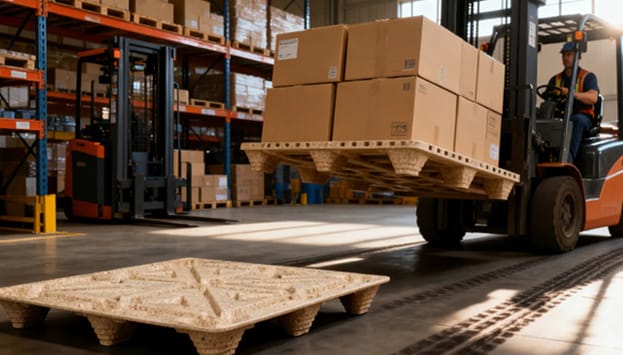
Before approving a shipping pallet, review the following areas.
Load
- Is the maximum loaded weight known?
- Is the load distributed evenly?
- Are there concentrated contact points?
- Could the center of gravity create instability?
Pallet Structure
- Does the deck support the cargo footprint?
- Are reinforcing areas located where they are needed?
- Does the lower structure suit forklifts and storage equipment?
- Is the pallet appropriate for the expected handling cycle?
Capacity
- Has static performance been considered?
- Has dynamic handling been considered?
- Will the pallet enter racking?
- Will loaded pallets be stacked?
Dimensions
- Does the cargo overhang the pallet?
- Is there excessive unused deck area?
- Does the pallet work with available handling equipment?
- Does the footprint support efficient storage and transportation?
Operating Conditions
- Will environmental conditions change during transport?
- How long will the pallet remain loaded?
- Is dimensional consistency important?
- Will the pallet interact with automated equipment?
A shipping pallet that meets these questions is more likely to perform consistently across the complete logistics process.
Conclusion
The key difference between a shipping pallet and a pallet used only in a controlled warehouse is the range of conditions it must tolerate.
Shipping introduces more transfers, changing support conditions, vibration, longer loaded periods, different equipment, and less predictable handling. That means pallet selection should consider far more than dimensions and a nominal load capacity.
Start with the product. Understand its total weight, footprint, contact points, and load distribution. Then examine how the pallet will be lifted, stored, stacked, transported, and handled at each stage.
Only then should you finalize material, structure, dimensions, fork entry, pallet weight, and other design details.
The most effective shipping pallet is not necessarily the heaviest or strongest-looking option. It is the one that provides appropriate support where the cargo needs it, remains compatible with handling systems, uses space efficiently, and maintains predictable performance throughout the intended shipping cycle.
FAQ
What is a shipping pallet?
A shipping pallet is a load platform used to support goods during handling, storage, and transportation. Its design should match cargo weight, load distribution, forklift requirements, storage conditions, dimensions, and the expected shipping environment rather than being selected by size alone.
How do I choose the right shipping pallet?
Begin with the complete unit load. Check weight, product footprint, contact points, handling equipment, stacking, rack use, environmental conditions, and shipping duration. Then select the pallet material, structure, dimensions, and entry design that best match those operating requirements.
How much weight can a shipping pallet hold?
Shipping pallet capacity varies according to material, structural design, dimensions, load distribution, and support conditions. Static floor loading and dynamic forklift handling are different situations, so one load figure should not be assumed to represent every stage of pallet use.
Are molded wood pallets suitable for shipping?
Molded wood pallets can be suitable for shipping when their structure, capacity, dimensions, and material characteristics match the cargo and handling conditions. Integrated molded geometry can also provide consistent dimensions, reinforcing features, and nestable configurations.
What size shipping pallet should I use?
Choose a shipping pallet that supports the product footprint without unnecessary overhang or excessive unused deck area. The final size should also work with forklifts, racks, conveyors, stacking arrangements, warehouse space, and the intended transportation configuration.