
Table of Contents
Introduction
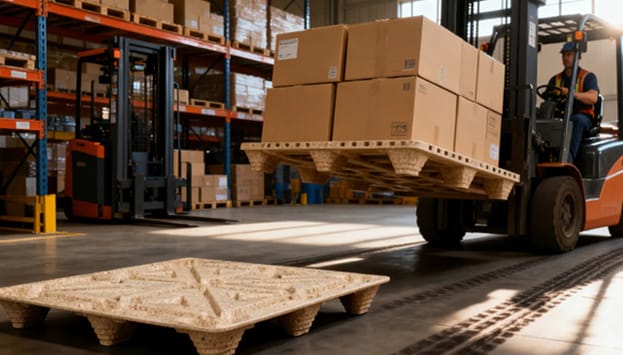
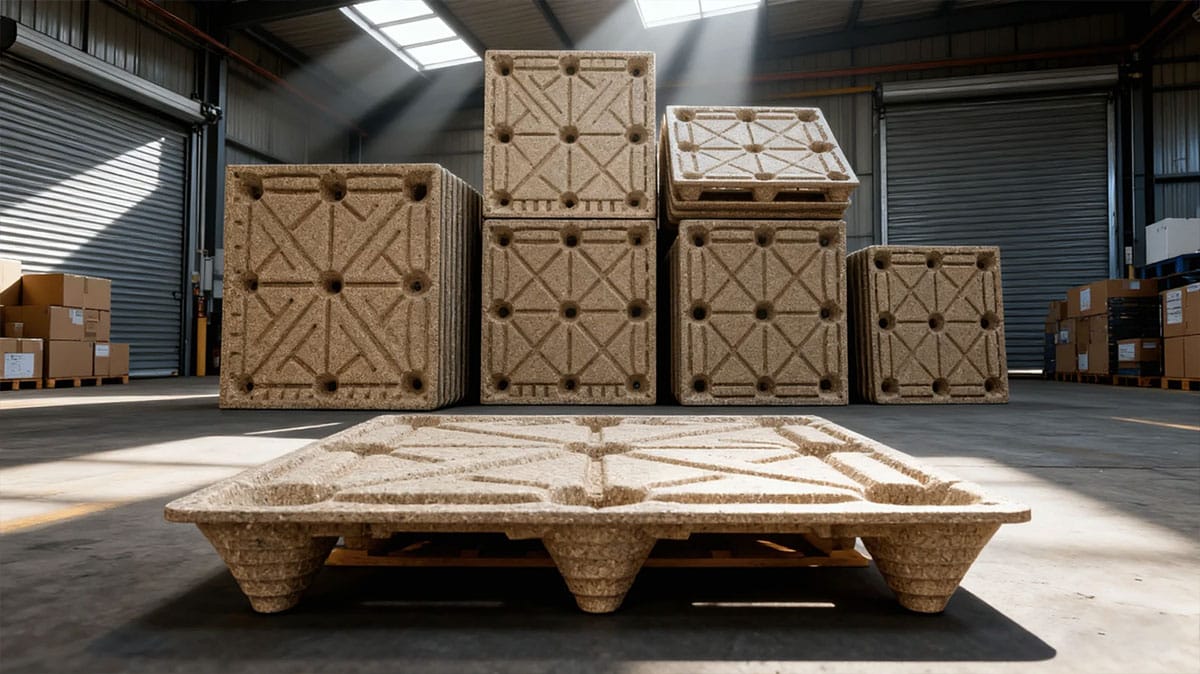
Warehouse efficiency is often discussed in terms of racking systems, forklifts, conveyors, inventory software, and automation. Yet one of the most frequently handled pieces of equipment in the facility is much simpler: the pallet beneath the load.
Warehouse pallets influence how products are stored, lifted, stacked, transferred, and positioned. Their dimensions affect rack compatibility and floor-space utilization. Their structure influences how loads are supported. Fork-entry design changes the way operators approach them, while dimensional consistency becomes increasingly important when conveyors or automated handling systems are involved.
The general pallet concept has been used to simplify unit-load handling for decades, but modern warehouse requirements make pallet selection more technical than simply choosing a familiar size.
A pallet that performs well for floor storage may not necessarily be suitable for racking. A lightweight design that works for cartons may require a different structure for bulk bags or industrial equipment. Likewise, a warehouse pallet used mainly with forklifts does not have exactly the same requirements as one moving repeatedly through automated conveyors.
Good selection starts with understanding the operation rather than the pallet itself.
What Makes Warehouse Pallets Different From General Shipping Pallets?
Warehouse pallets and shipping pallets can sometimes be the same physical product, but their selection priorities are often different.
Shipping places greater emphasis on the broader distribution cycle, while warehouse operations concentrate heavily on repeatable handling, storage compatibility, space utilization, and interaction with material-handling equipment.
A warehouse may handle the same pallet many times during its operating cycle.
Typical activities include:
- receiving goods
- temporary staging
- forklift transport
- floor stacking
- rack storage
- order preparation
- conveyor movement
- production-line transfer
- outbound staging
Repeated movement makes dimensional consistency and handling geometry particularly important.
Predictability Changes the Selection Process
A warehouse is usually more controlled than an open logistics network.
You often know:
- which forklifts are being used
- rack dimensions
- aisle widths
- conveyor configuration
- expected product types
- storage duration
- pallet orientation
This allows warehouse pallets to be selected more precisely around actual equipment and operating conditions.
The opportunity is significant: rather than accepting a general-purpose pallet, you can match the structure to the warehouse system.
Start With the Products Being Stored
Warehouse pallet selection should begin with cargo characteristics.
Weight is important, but it is not enough by itself.
Distributed Loads
Cartons and packaged products commonly spread their weight across a large portion of the pallet deck.
When the load is relatively uniform, the deck can transfer pressure across several structural areas.
However, carton arrangement still matters. Gaps between cartons or uneven stacking may create less predictable loading than the total weight suggests.
Concentrated Loads
Machinery, drums, bulk containers, industrial components, and equipment mounted on feet create more concentrated pressure.
A warehouse pallet carrying this type of load may need reinforcement beneath specific contact areas.
The total weight may be within the pallet’s nominal capacity while individual areas of the deck experience much higher stress.
This is why cargo contact points deserve attention.
High-Center-of-Gravity Loads
Tall loads introduce another challenge.
Even when the warehouse pallet itself has sufficient structural capacity, a high center of gravity can make the complete unit load less stable during:
- turning
- braking
- lifting
- lowering
- rack placement
Pallet selection and load arrangement therefore need to support one another.
Understand Static, Dynamic, and Racking Requirements
Warehouse pallets rarely experience only one loading condition.
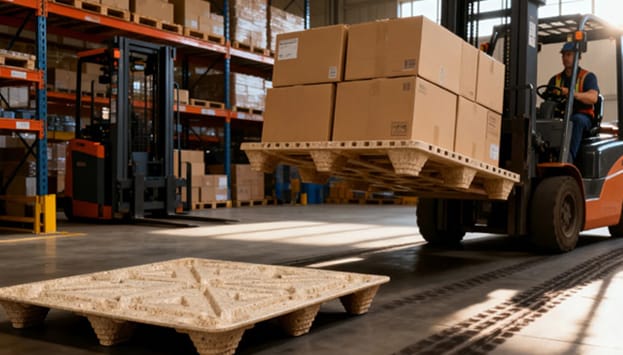
The same pallet may sit on a floor, be lifted by a forklift, and later be placed in rack storage.
Each situation creates different structural stresses.
Static Loading
A pallet resting on a warehouse floor usually receives broad support underneath.
This generally provides a favorable structural condition because the load can be distributed through a larger portion of the base.
Static capacity is useful when products spend substantial time in floor storage.
However, it does not describe every part of warehouse operation.
Dynamic Handling
Once a forklift lifts the loaded pallet, the support condition changes.
The pallet is now carried by fork blades positioned beneath selected areas of the structure.
Movement introduces additional stresses from:
- acceleration
- braking
- turning
- vibration
- lifting
- minor handling impacts
For warehouse pallets moved frequently between receiving, storage, production, and dispatch zones, dynamic behavior deserves close attention.
Racking Loads
Rack storage can be structurally demanding because support may be limited to specific beam locations.
The center of the pallet may have less support than it receives on the floor.
Before using a warehouse pallet in racking, consider:
- beam spacing
- pallet orientation
- load distribution
- unsupported span
- storage duration
- maximum unit-load weight
Do not treat a high static capacity as proof that a pallet is automatically suitable for every rack configuration.
Pallet Structure Matters as Much as Material
Warehouse teams often begin selection by discussing wood, molded wood, or plastic.
Material matters, but structural geometry can be equally important.
A pallet works because its deck and supporting structure distribute forces effectively.
Single-Deck Warehouse Pallets
Single-deck designs can be useful in operations where lower pallet weight and empty-pallet storage are important.
Some designs can also be nested, reducing the amount of space needed when the pallets are empty.
Their suitability depends on the load and support conditions.
Double-Deck Pallets
Double-deck warehouse pallets include additional lower structural areas.
Depending on the design, these can provide greater support, improved stability, or better interaction with particular handling and storage systems.
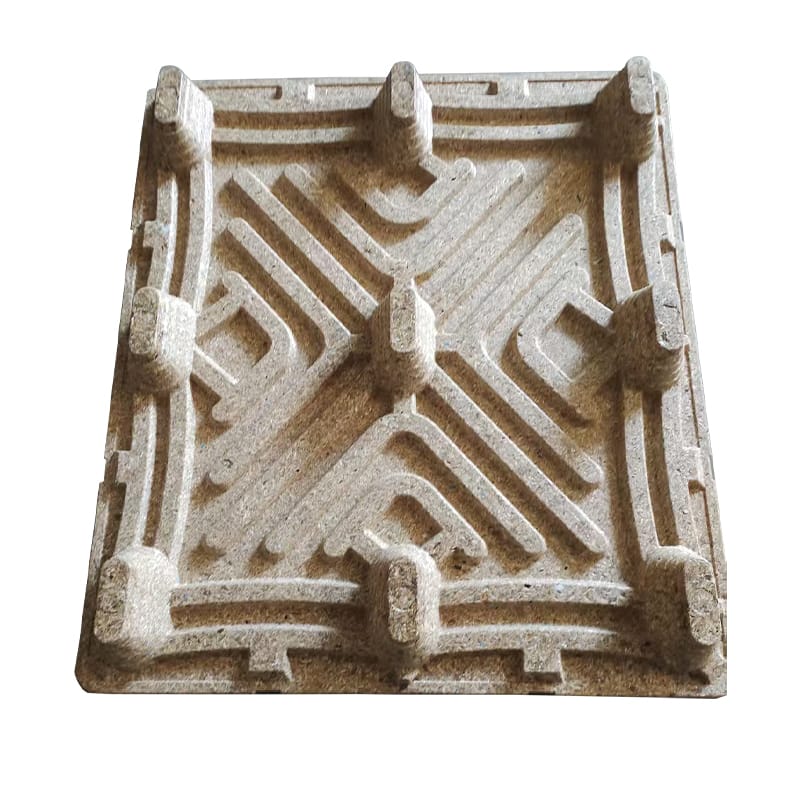
For example, Xinyi’s double-deck square-grid pallets use integrated molded geometry across the upper and lower structure for industrial warehousing and material-handling applications.
The correct choice still depends on how the pallet will be supported and handled.
Ribs, Legs, and Runners
These structural elements are not merely shape features.
Their positions influence:
- deck stiffness
- fork access
- local load support
- pallet stability
- rack performance
- conveyor contact
A well-designed pallet places structural support where the warehouse operation actually requires it.
Choosing Warehouse Pallets for Different Storage Methods
Storage method should be identified before finalizing a pallet specification.
Different warehouse systems place different demands on the pallet.
| Warehouse Condition | Main Pallet Requirement | What to Evaluate | Common Mistake |
|---|---|---|---|
| Floor storage | Stable base support | Static capacity and load distribution | Selecting only by dimensions |
| Block stacking | Stable upper and lower surfaces | Stack alignment and compression | Ignoring cumulative stacked load |
| Selective racking | Suitable spanning performance | Beam position and pallet orientation | Using static capacity as rack capacity |
| Conveyor handling | Consistent lower geometry | Contact surfaces and dimensions | Checking only forklift entry |
| Automated storage | High dimensional repeatability | Tolerances, openings and orientation | Accepting inconsistent pallet geometry |
| Frequent forklift movement | Dynamic stability | Entry clearance and structural rigidity | Ignoring handling impacts |
| Bulk bag storage | Broad load support | Deck area and load concentration | Focusing only on total weight |
| Machinery storage | Local reinforcement | Product contact points | Assuming distributed-load performance |
This comparison shows why there is no universal warehouse pallet specification.
The operating environment determines which characteristics matter most.
Floor Storage and Block Stacking
Floor storage appears simple because pallets receive broad support from below.
However, stacking introduces additional considerations.
Understand the Complete Stack
When loaded pallets are placed on top of one another, the lower units experience additional compression.
The upper pallet may also transfer force through only certain structural areas.
For this reason, warehouse pallet selection should consider both the weight of an individual unit load and the intended stacking configuration.
Alignment Matters
Poorly aligned stacks can transfer forces unevenly.
If one pallet is offset significantly from the pallet below it, support may move toward weaker deck or edge areas.
Consistent dimensions help warehouse operators create more predictable stacks.
Cargo Packaging Is Part of the Stack
The pallet cannot compensate for weak or unstable packaging.
Cartons, containers, wrapping, straps, and pallet structure need to work together if loaded units are expected to remain stacked for extended periods.
Warehouse Pallets for Rack Storage
Racking is one area where pallet selection errors can become especially noticeable.
A pallet that performs perfectly on the floor may deflect differently when supported by beams.
Rack Configuration Comes First
Before choosing warehouse pallets for rack use, document:
- rack opening width
- beam spacing
- beam profile
- expected pallet orientation
- maximum load
- storage duration
This information gives the pallet manufacturer a more realistic picture of the application.
Pallet Orientation
Some pallet structures perform differently depending on how they are oriented relative to the rack beams.
Warehouse operating procedures should therefore match the intended pallet orientation when the design requires it.
Deflection Deserves Attention
A pallet does not need to break to create operational problems.
Excessive deflection can affect load stability, product support, and interaction with surrounding rack components.
This is one reason load ratings need to be associated with actual support conditions rather than treated as universal values.
How Forklift Handling Influences Pallet Selection
Forklift compatibility affects everyday warehouse productivity.
If operators struggle to enter a pallet cleanly, even a strong design can create unnecessary handling problems.
Fork Opening Height
There should be enough clearance for the fork blades to enter without repeatedly hitting deck or lower structural components.
Small clearances can become troublesome during fast-paced operations.
Fork Spacing
The pallet structure should accommodate the equipment used in the facility.
Supporting legs, runners, or molded ribs should not interfere with normal fork positioning.
Two-Way vs Four-Way Entry
Four-way warehouse pallets can improve handling flexibility where pallets are approached from several directions.
This can be helpful in:
- staging areas
- busy aisles
- loading zones
- production environments
Two-way entry may still be suitable where movement is highly controlled.
Entry configuration should follow the workflow rather than simply being treated as a feature upgrade.
Handling Impacts
Forklift contact is rarely perfect.
Minor impacts around entry areas are common in active warehouses.
A practical warehouse pallet should therefore provide appropriate structural strength around frequently contacted areas without creating unnecessarily restrictive openings.
Warehouse Pallets for Conveyors
Conveyor systems introduce requirements that may not exist in basic forklift operations.
The lower surface of the pallet becomes particularly important.
Conveyor Contact Points
Warehouse pallets need appropriate support where they meet rollers, chains, or other conveying components.
Large unsupported gaps or incompatible lower geometry can create poor movement.
Direction of Travel
Some pallet structures perform differently depending on conveyor orientation.
The facility should determine whether the pallet will move:
- lengthwise
- widthwise
- in both directions
before the design is finalized.
Transfer Points
Movement between conveyor sections may create short periods of reduced support.
Pallet structure needs to remain sufficiently stable during these transfers.
Consistent bottom geometry helps make the movement more predictable.
Why Automation Makes Pallet Consistency More Important
Automated warehouses place greater emphasis on dimensional repeatability.
Human operators can compensate for small variations. Machines generally expect the pallet to arrive within defined tolerances.
Dimensions
Automated systems may depend on consistent:
- length
- width
- height
- fork openings
- bottom structure
- deck position
A pallet that varies noticeably from one production batch to another can create positioning problems.
Sensor Interaction
Pallet geometry can also influence how sensors detect and position loads.
Features that seem unimportant during manual handling may become relevant when automated systems are involved.
Repeatable Orientation
If the warehouse pallets have different structural characteristics on different sides, clear operating rules may be needed to maintain the intended orientation.
Automation should therefore be discussed with the pallet manufacturer from the beginning rather than added as an afterthought.
How Dimensions Affect Warehouse Efficiency
Warehouse pallet dimensions directly influence storage density.
A size that works poorly with the product can waste space even when the pallet itself performs correctly.
Product Overhang
Cargo extending beyond the pallet edge can:
- lose deck support
- contact nearby loads
- increase packaging damage
- interfere with storage positions
Where practical, warehouse pallets should support the complete product footprint.
Excessive Unused Deck Area
The opposite problem occurs when the pallet is considerably larger than the cargo.
Unused pallet area consumes:
- rack width
- floor space
- staging space
- handling clearance
When repeated across hundreds or thousands of storage positions, small inefficiencies become meaningful.
Match Pallet and Packaging Layout
Carton orientation can often improve pallet utilization.
Before choosing a different pallet size, test whether changing the layer pattern can reduce unused space or overhang.
The existing Xinyi guide to types of pallets also provides a useful basis for comparing structural formats when dimensions, deck configuration, and handling method all need to be considered together.
Common Warehouse Pallet Dimensions
Different industrial applications use different footprints, and no single dimension suits every warehouse.
Examples of practical molded pallet sizes can include:
- 1050 × 1050 mm
- 1100 × 900 mm
- 1100 × 1100 mm
- 1200 × 1000 mm
- 1200 × 1100 mm
- 1200 × 1200 mm
- 1300 × 1100 mm
The better question is not which size is most common.
It is which size fits your operation most efficiently.
Evaluate the relationship between:
- product footprint
- rack dimensions
- forklift access
- aisle width
- conveyor system
- load capacity
- stacking pattern
A larger warehouse pallet does not automatically provide better performance.
Material Selection for Warehouse Pallets
Warehouse pallet material should match the operating environment and handling cycle.
Traditional Wood
Traditional wood pallets can be adapted to many dimensions and structures.
Performance can depend on:
- lumber quality
- board dimensions
- moisture
- fasteners
- joints
- production consistency
These variables become more important as pallet loads and handling frequency increase.
Molded Wood and Plant-Fiber Designs
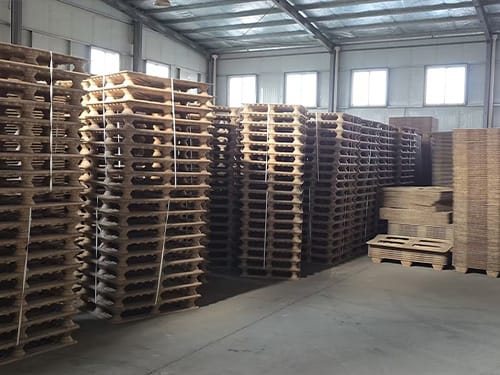
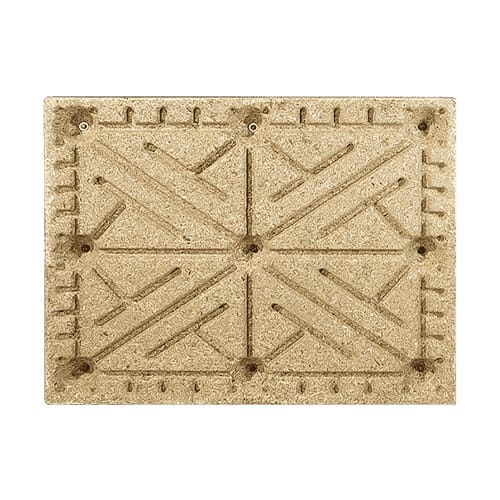
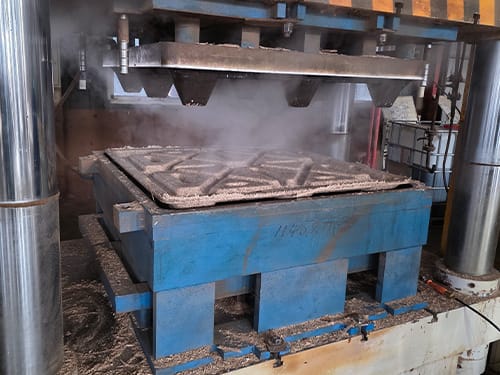
Molded pallets can integrate the deck, reinforcement, and supporting areas into a formed structure.
For warehouse applications, useful characteristics may include:
- repeatable geometry
- integrated ribs
- controlled dimensions
- nestable designs
- no conventional board-and-nail assembly
The actual suitability still depends on load requirements and warehouse equipment.
Other Materials
Plastic and other engineered pallet materials can be suitable for particular warehouse environments.
Instead of choosing material first, define the operational requirements and then determine which material and structure meet them most effectively.
Empty Warehouse Pallets Also Consume Space
Pallet selection should not stop at loaded performance.
Warehouses also need to store pallets before and after use.
Stackable Designs
Stackable pallets can be placed directly on top of one another when empty.
Their overall height influences how much vertical storage space a stack consumes.
Nestable Designs
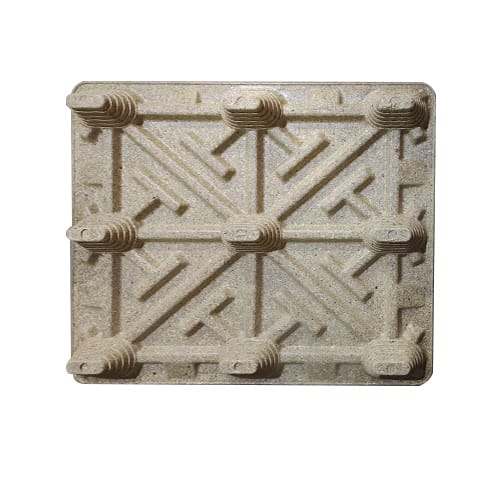
Some molded warehouse pallets allow legs or supporting structures to fit partially inside the pallet below.
This can significantly reduce the volume of empty pallet stacks.
Nesting may be valuable where:
- empty pallets accumulate quickly
- staging space is limited
- warehouse floor space is heavily utilized
- pallets are moved between production areas
However, empty-storage efficiency should remain secondary to loaded performance.
Pallet Weight and Warehouse Handling
Pallet tare weight is easy to overlook because attention is usually focused on the cargo.
However, the pallet is moved every time the load moves.
A heavier pallet contributes additional mass to:
- forklift operations
- conveyors
- storage equipment
- manual repositioning
- automated handling systems
The objective should be sufficient structural capacity rather than unnecessary mass.
Efficient pallet engineering uses material where it contributes meaningfully to load support.
When Do Custom Warehouse Pallets Make Sense?
Custom dimensions or structures are useful when a standard pallet creates a recurring operational problem.
Customization should solve something measurable.
Unusual Product Footprints
Large equipment, sheets, industrial components, or specialized containers may require a deck designed around their dimensions.
Concentrated Loads
A product supported by several narrow feet may benefit from reinforcement aligned with those specific contact areas.
Specialized Conveyors
Custom lower geometry may be required when existing warehouse pallets do not interact correctly with a conveyor system.
Automated Operations
An automated warehouse may require tighter dimensional consistency or a specific pallet configuration.
High-Volume Repetitive Loads
If the same product configuration is handled repeatedly, optimizing the pallet around that unit load can make more sense than accepting recurring space or handling inefficiencies.
What Should You Tell a Warehouse Pallet Manufacturer?
A manufacturer can make a better recommendation when provided with detailed operating information.
Instead of asking only for a pallet with a certain size and capacity, describe the application.
Useful information includes:
- maximum unit-load weight
- product dimensions
- packaging arrangement
- location of concentrated loads
- total loaded height
- forklift specifications
- required entry directions
- rack configuration
- conveyor use
- automated handling requirements
- stacking method
- expected handling frequency
- storage duration
- warehouse environmental conditions
For unusual loads, drawings or photographs can make the requirement easier to evaluate.
Common Warehouse Pallet Selection Mistakes
Some problems appear repeatedly in warehouse operations.
Selecting by Static Capacity Alone
The pallet may spend most of its time moving or sitting in racks rather than resting fully supported on the floor.
Dynamic and racking requirements need separate consideration.
Ignoring Product Contact Points
Total weight does not show how pressure reaches the deck.
Concentrated loads should be identified before the pallet is selected.
Choosing Dimensions by Habit
A familiar pallet size may not fit the product or storage system efficiently.
Ignoring Forklift Clearance
Small entry openings can reduce handling efficiency and increase pallet impacts.
Forgetting About Automation
A pallet suitable for manual forklift handling may not automatically provide the consistency needed by automated equipment.
Overlooking Empty Storage
Empty warehouse pallets require floor space too. Nesting or efficient stacking can become important in high-volume operations.
A Practical Warehouse Pallet Selection Checklist
Before confirming a pallet specification, review the following areas.
Product
- What is the complete unit-load weight?
- Are there concentrated loads?
- Does the product fit within the pallet footprint?
- Is the center of gravity stable?
Storage
- Will pallets remain on the floor?
- Will loaded pallets be stacked?
- Are racks involved?
- What support conditions exist in the rack?
Handling
- Which forklifts are used?
- Is four-way entry necessary?
- Are the openings large enough?
- How frequently will the pallet move?
Equipment
- Will pallets travel on conveyors?
- Is automated storage involved?
- Are dimensional tolerances important?
- Does the lower structure match equipment contact points?
Dimensions
- Is there product overhang?
- Is excessive pallet area unused?
- Does the footprint fit storage locations?
- Is a different product arrangement more efficient?
Empty Pallet Management
- Will empty units be stacked or nested?
- How much storage area is available?
- Is pallet tare weight important to the operation?
A clear answer to these questions provides a much stronger specification than simply requesting a general-purpose warehouse pallet.
Conclusion
Warehouse pallets are an important part of storage and material-handling efficiency because they interact directly with products, forklifts, racks, conveyors, and automated systems.
The right pallet begins with the load. Weight distribution, product footprint, concentrated contact points, and stability need to be understood before capacity or material is selected.
The next step is the warehouse itself. Floor storage, block stacking, rack support, forklift entry, conveyor design, automation, and available storage space can all change which pallet structure is most appropriate.
There is therefore no single warehouse pallet that is ideal for every operation.
A strong pallet can still be inefficient if its dimensions waste storage space. A lightweight pallet can still perform effectively when its structure matches the load. A familiar pallet size can become unsuitable when rack beams or automated equipment require different geometry.
The best warehouse pallets are those selected around the actual operating conditions. When dimensions, structural design, load performance, handling compatibility, and empty-pallet storage are considered together, the pallet becomes a practical tool for improving warehouse consistency rather than simply a platform beneath the product.
FAQ
What are warehouse pallets used for?
Warehouse pallets support goods during storage, forklift handling, staging, stacking, racking, and internal material movement. The correct pallet should match the cargo weight, product footprint, handling equipment, storage method, and any conveyor or automated systems used in the facility.
How do I choose the right warehouse pallets?
Start with cargo weight and load distribution, then review floor storage, stacking, rack support, forklifts, conveyors, dimensions, and automation requirements. A suitable warehouse pallet should fit both the product and the material-handling system instead of being selected by capacity alone.
Can warehouse pallets be used in pallet racks?
Some warehouse pallets can be used in racks, but suitability depends on structure, load distribution, pallet orientation, rack-beam spacing, and the unsupported span. Static floor capacity should not automatically be treated as rack capacity, so rack conditions should be confirmed first.
What size warehouse pallets should I use?
Choose a footprint that supports the packaged product without excessive overhang or unused deck space. The dimensions should also match forklifts, racks, conveyors, aisle clearances, stacking arrangements, and storage positions. Standard sizes are useful only when they fit the operation.
Are molded wood warehouse pallets suitable for industrial storage?
Molded wood warehouse pallets can be suitable when their structural design, dimensions, capacity, and entry configuration match the application. Integrated ribs and support areas can provide consistent geometry, while some molded structures also allow more efficient empty-pallet nesting.