
Table of Contents
Introduction
Selecting a pallet for heavy-duty export loads is more complicated than choosing a platform with a large load-capacity number.
The pallet becomes part of the complete unit-load system. It must support the cargo during storage, remain stable while being lifted by a forklift, tolerate repeated handling, work with warehouse equipment, and maintain its structure throughout transportation.
A useful way to think about pallet selection is to follow the load path:
cargo → pallet deck → pallet structure → handling equipment → storage support → transportation
If one part of this load path is overlooked, a pallet that appears strong enough on paper may perform very differently in actual use.
The basic pallet concept is simple: it creates a stable platform for storing, handling, and transporting goods. Heavy-duty export applications, however, require a much closer look at load distribution, structural design, materials, dimensions, support conditions, and handling methods.
Before selecting a pallet, you should be able to answer several questions:
- What is the maximum complete unit-load weight?
- Is the weight evenly distributed?
- Where does the product contact the pallet?
- Will forklifts handle the load frequently?
- Will the pallet be stacked?
- Will it be stored on the floor or in pallet racking?
- Will it travel through conveyors or automated systems?
- What environmental conditions will it encounter?
These questions provide a much stronger basis for pallet selection than simply asking for the highest possible load rating.
Start With the Actual Load, Not Just the Weight
The first step in choosing a pallet is understanding what the pallet will actually carry.
Total weight matters, but weight alone does not describe the forces acting on the pallet.
Total Unit Load
Calculate the complete unit load rather than only the weight of the product.
Depending on the application, the total can include:
- primary products
- cartons or containers
- protective packaging
- straps
- wrapping materials
- intermediate layers
- other load-securing components
The pallet structure must safely support the complete unit throughout handling and storage.
Load Distribution
Two loads with identical total weight can create completely different stresses.
Imagine one pallet carrying evenly distributed cartons across the whole deck. Another pallet carries a dense industrial component supported by four narrow feet.
Although the total load may be equal, the second pallet experiences much higher localized stress.
This is why load distribution should always be discussed with the pallet manufacturer.
Concentrated Loads
Concentrated loading is particularly important for:
- machinery
- drums
- tanks
- bulk bags
- dense industrial components
- sheet materials
- irregular packaging
In these applications, specific areas of the pallet may need stronger structural support.
Center of Gravity
A tall or uneven unit load can also create stability problems.
The center of gravity becomes increasingly important when the pallet is:
- lifted
- accelerated
- turned
- stopped
- tilted
- moved across uneven surfaces
The issue is no longer simply vertical loading. Dynamic forces begin acting on the entire palletized system.
Understand the Three Types of Pallet Load Capacity
One of the most important concepts in heavy-duty pallet selection is that load capacity is not a single universal number.
A pallet behaves differently depending on how it is supported.
Static Load Capacity
Static load capacity describes the pallet while it is resting on a relatively stable surface.
When the pallet sits directly on a warehouse floor, much of its lower structure can receive continuous support.
This normally creates a more favorable loading condition.
Dynamic Load Capacity
Dynamic capacity becomes important while the loaded pallet is being moved.
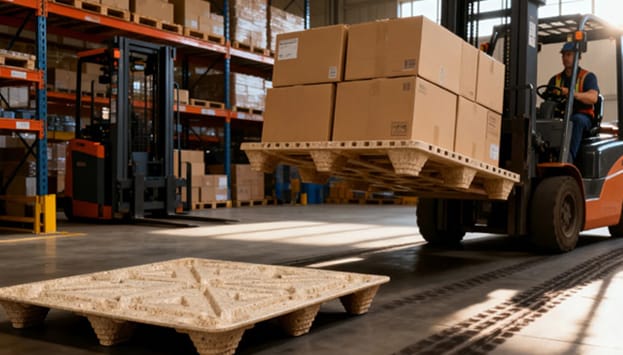
When forklift blades support the pallet, only specific areas are carrying the load. Movement also introduces:
- bending
- vibration
- acceleration
- impact
- turning forces
- repeated lifting cycles
A pallet suitable for stationary floor storage may therefore require additional structural capability for frequent material handling.
Racking Load Capacity
Racking creates another structural condition.
Instead of receiving continuous support from the floor, the pallet may bridge between rack beams or other limited support points.
The unsupported central area can experience significant bending.
For this reason, never assume:
static capacity = dynamic capacity = racking capacity
They represent different operating conditions.
Ask for Load Conditions, Not Just Load Numbers
When discussing capacity with a pallet supplier, ask:
- What is the static load capacity?
- What is the dynamic load capacity?
- Is the pallet intended for rack storage?
- What load distribution was assumed?
- What support configuration was used?
- Are concentrated loads acceptable?
The answers are much more valuable than a single maximum-load figure.
Choose the Right Pallet Material for Export Loads
Material selection affects pallet strength, dimensional stability, moisture behavior, weight, cleanliness, manufacturing consistency, and export handling.
There is no universal material that is automatically best for every application.
The correct material is the one that works with your cargo and logistics conditions.
Traditional Wood Pallets
Conventional timber pallets are widely used because their structures and dimensions can be adapted to many cargo types.
Performance can depend on several variables, including:
- board thickness
- lumber quality
- moisture level
- fastener position
- joint design
- runner dimensions
- production consistency
These factors become more important as load requirements increase.
Molded and Pressed Wood Pallets
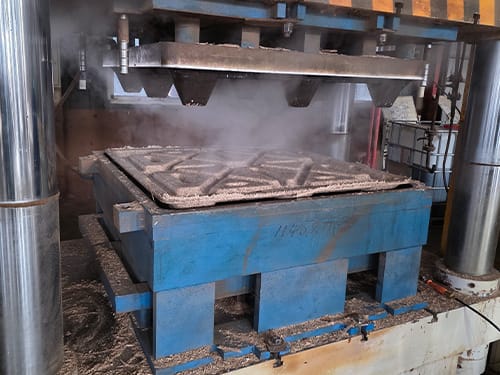
Molded wood construction uses processed plant-based material formed under controlled pressure and temperature.
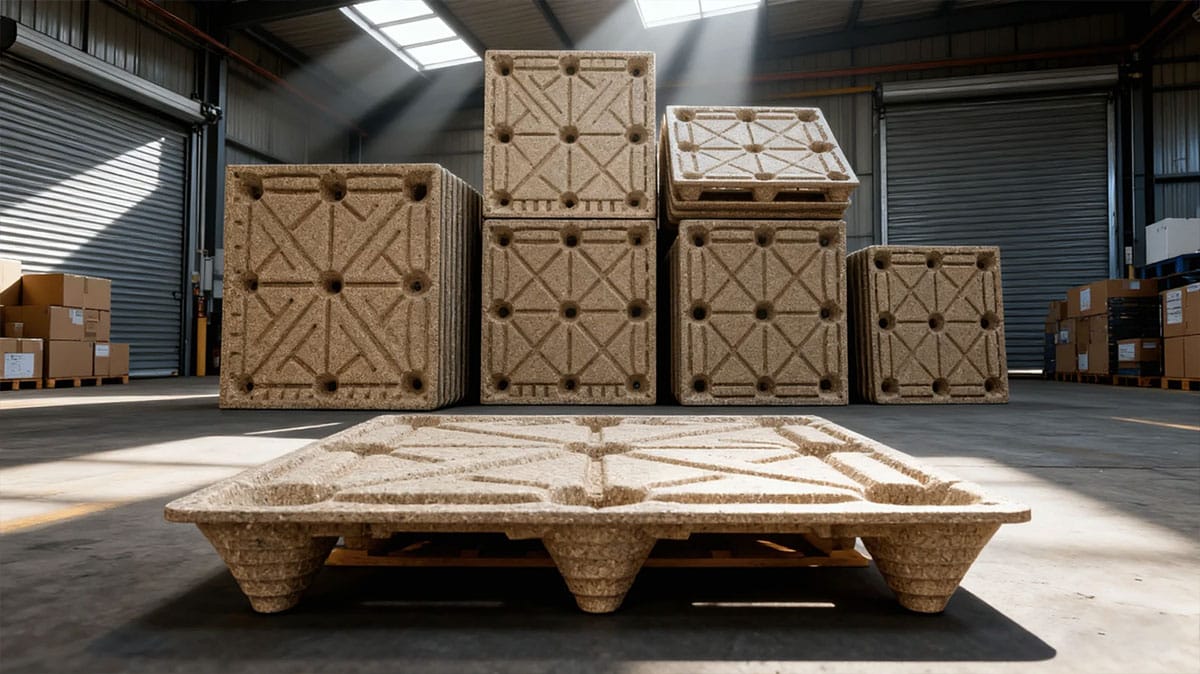
Rather than assembling individual boards with fasteners, the structure can integrate features such as:
- deck surfaces
- supporting legs
- reinforcing ribs
- load-bearing zones
- fork-entry areas
This creates opportunities to control the geometry of the pallet more consistently.
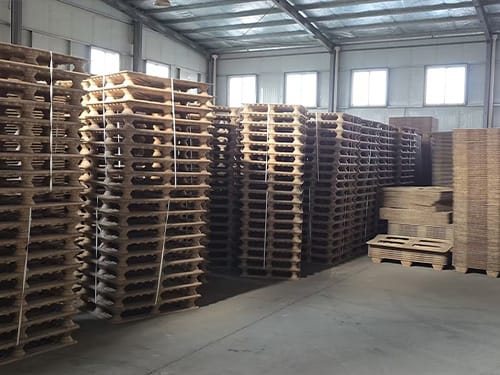
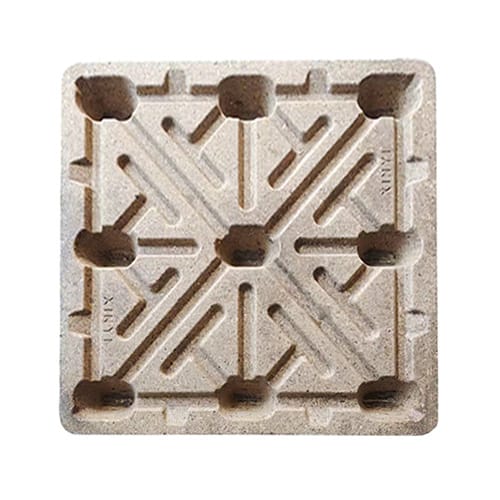
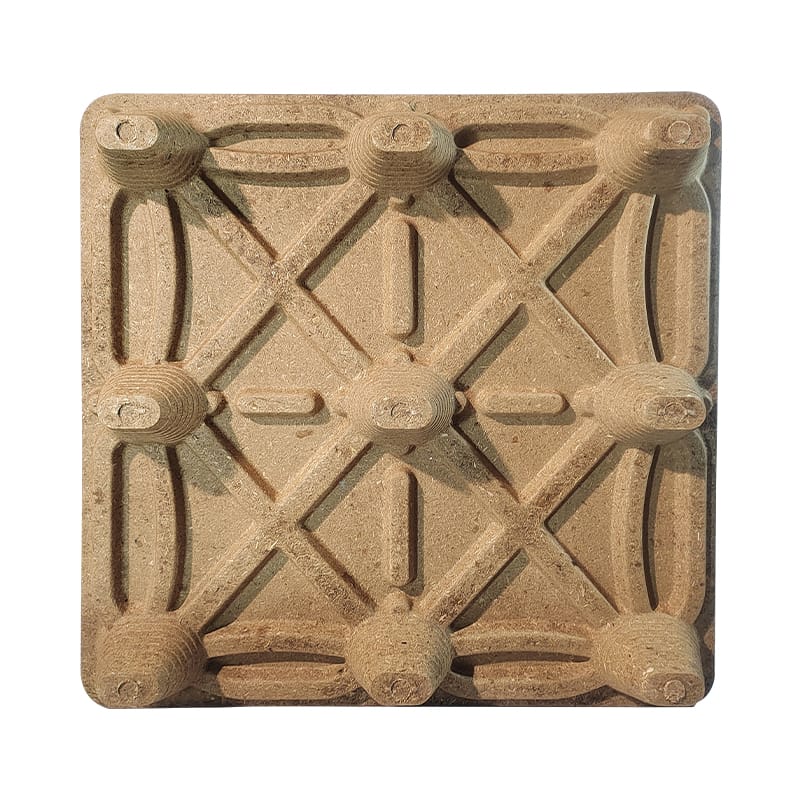
For example, Xinyi Pallet’s double-deck square-grid pallet series uses an integrated molded structure designed around industrial handling and load support.
For heavy-duty applications, the important question is not simply whether a pallet is molded or traditionally assembled. You should examine how the complete structure transfers forces from the cargo to the supporting surface.
Other Pallet Materials
Other pallet materials may also be appropriate depending on operating conditions.
Material comparisons should consider:
- load behavior
- environmental exposure
- dimensional consistency
- handling frequency
- storage method
- pallet weight
- product cleanliness requirements
Avoid selecting a pallet based only on the material name.
Structure matters just as much.
Evaluate Pallet Structure and Deck Design
A pallet is an engineered structure.
Its deck, ribs, runners, feet, grids, corners, and lower supports all influence how forces travel through the unit.
Single-Deck vs Double-Deck Pallet
A single-deck design may offer advantages when reduced material use, nesting, or empty pallet storage is important.
A double-deck pallet can provide more lower support and may be appropriate when greater stability or more complex load transfer is required.
Neither design is automatically superior.
Your decision should depend on:
- cargo type
- handling equipment
- storage method
- stacking conditions
- required structural rigidity
Structural Ribs and Load Paths
The purpose of reinforcement is not simply to make a pallet look stronger.
Good structural design distributes stress.
When a load reaches the pallet deck, forces need to travel through ribs, runners, legs, or other supports before reaching the floor, forklift blades, or rack beams.
Poor geometry can create isolated stress points.
Effective geometry spreads those stresses across a larger portion of the structure.
Contact Area Matters
Pay attention to where the cargo touches the pallet.
A carton layer covering most of the deck creates a very different loading condition from a machine supported on four small mounting points.
For concentrated loads, it may be more effective to reinforce specific areas than to increase material throughout the entire pallet.
This is one reason detailed load information is so valuable during custom pallet selection.
Match the Pallet to Forklift and Handling Equipment
A pallet cannot be evaluated independently from the equipment that moves it.
Forklift compatibility has a direct effect on both safety and durability.
Two-Way vs Four-Way Entry
Two-way entry allows forks to approach from two opposing directions.
Four-way entry provides greater access flexibility, which can be useful in operations with:
- frequent repositioning
- narrow handling spaces
- multiple forklift directions
- busy warehouse workflows
However, entry configuration should be selected according to actual operational needs rather than assumed to be a quality level.
Fork Clearance
Check:
- fork blade width
- fork thickness
- fork spacing
- entry height
- pallet clearance
Poor entry geometry can lead to repeated impacts between forklift blades and pallet structures.
A pallet can be mechanically strong yet suffer premature damage if the operator regularly strikes its legs or deck during entry.
Conveyor Compatibility
If the pallet enters a conveyor system, additional factors matter.
These can include:
- bottom geometry
- contact surfaces
- pallet flatness
- dimensional repeatability
- sensor interaction
- transfer direction
Automated systems usually require greater dimensional consistency than basic floor-and-forklift operations.
Choose Pallet Dimensions Around the Cargo
Standard pallet dimensions can simplify logistics, but the product footprint should still guide selection.
A familiar size is not always the most efficient size.
Prevent Product Overhang
Overhang occurs when the product extends beyond the pallet perimeter.
This can expose the cargo to impact during:
- forklift movement
- warehouse storage
- loading
- unloading
- pallet-to-pallet contact
It may also reduce load stability.
Where practical, the pallet deck should adequately support the product footprint.
Avoid Excessive Underhang
The opposite situation can also be inefficient.
If a relatively small product is placed on an unnecessarily large pallet, unused deck area consumes space throughout the logistics chain.
That affects:
- warehouse density
- transport utilization
- loading configuration
- handling clearance
Bigger does not automatically mean better.
Consider the Entire Logistics Footprint
Pallet dimensions should work with more than the cargo.
They can also influence:
- storage locations
- rack dimensions
- forklift movement
- stacking arrangements
- transport layout
- packaging configuration
A broader comparison of different types of pallets can help identify which structural format best matches the intended logistics process before selecting final dimensions.
Consider Export and Material Requirements
Heavy-duty export pallet selection requires both mechanical and practical evaluation.
The pallet may pass through multiple handling stages, storage environments, and inspection processes.
Material processing methods can therefore matter alongside physical performance.
Raw wood and engineered or processed wood materials are not always treated in exactly the same way under applicable packaging requirements.
The safest approach is to confirm:
- pallet material
- manufacturing process
- documentation
- intended shipping use
- applicable packaging requirements
Avoid assuming that every product described broadly as a “wood pallet” has identical characteristics.
Documentation Supports Repeatability
For recurring industrial shipments, useful pallet documentation may include:
- material identification
- production specifications
- dimensions
- structural design
- load information
- manufacturing process
- quality-control records
Documentation becomes increasingly important when the same pallet specification is purchased repeatedly.
Evaluate Moisture and Storage Conditions
Pallets often move between different environments before reaching their final unloading point.
The pallet may experience:
- enclosed warehouses
- temporary loading areas
- high humidity
- temperature changes
- prolonged storage
- enclosed transportation environments
These conditions should be included in the initial selection process.
Dimensional Stability
Changes in moisture can affect some wood-based materials.
For operations using conveyors, racks, or automated systems, dimensional consistency may be particularly important because small dimensional changes can influence handling.
Storage Duration
A pallet used for rapid product turnover faces different conditions from one expected to remain heavily loaded for long periods.
When discussing requirements with the manufacturer, specify whether the pallet is intended for:
- short-term transit
- long-term storage
- repeated handling
- stacked storage
- rack storage
Cleanliness
Industrial packaging may also require predictable surface quality.
Check for conditions that could interfere with products or packaging, such as:
- loose material
- broken surfaces
- exposed fasteners
- contamination
- damaged corners
The required finish depends on the cargo and handling environment.
Balance Pallet Strength and Pallet Weight
A heavy-duty pallet should be strong, but unnecessary pallet mass does not automatically improve performance.
Good engineering seeks sufficient structural strength with efficient material distribution.
Think in Terms of Strength-to-Weight Efficiency
Rather than asking:
“How heavy is the pallet?”
ask:
“How efficiently does the pallet structure support the required load?”
Reinforcement should be concentrated where forces are actually transmitted.
This can improve structural efficiency without simply adding material everywhere.
Pallet Weight Affects Handling
The pallet itself becomes part of the total unit load.
Additional tare weight influences:
- forklift handling
- conveyor loading
- rack loading
- manual positioning
- overall logistics efficiency
For operations handling large numbers of pallets, the effect accumulates.
Nesting Can Improve Empty Storage
Some molded pallet designs can nest when empty.
Nesting reduces the volume required for:
- empty pallet storage
- warehouse movement
- pallet staging
- empty-pallet transport
However, nesting should remain secondary to loaded performance.
A pallet that stores efficiently when empty still has to perform correctly when carrying the required cargo.
Heavy-Duty Pallet Selection Comparison
| Application Condition | Main Factor to Check | Useful Pallet Characteristics | Common Selection Error |
|---|---|---|---|
| Heavy distributed cargo | Total load and deck coverage | Broad structural support | Looking only at static capacity |
| Concentrated machinery load | Contact points | Local reinforcement | Ignoring point loading |
| Frequent forklift movement | Dynamic behavior | Strong entry zones and adequate clearance | Using static ratings for dynamic use |
| Rack storage | Beam support and span | Suitable racking structure | Assuming all heavy-duty pallets are rackable |
| Stacked cargo | Load transfer | Stable upper and lower surfaces | Ignoring stacking compression |
| Conveyor handling | Bottom geometry | Repeatable dimensions and contact areas | Checking only forklift compatibility |
| Export logistics | Material and documentation | Consistent manufacturing process | Selecting only by pallet size |
| Space-sensitive storage | Footprint and nesting | Efficient dimensions | Using oversized pallets |
This table highlights an important principle:
The best pallet is not the one with the largest number in a specification sheet. It is the one whose structure matches the actual operating condition.
How to Evaluate a Pallet Manufacturer
For demanding export loads, pallet supplier evaluation should include technical capability.
A manufacturer should be able to discuss more than dimensions.
Can the Manufacturer Understand Your Load?
Provide information about:
- cargo weight
- cargo dimensions
- contact areas
- unit-load height
- center of gravity
- stacking method
- forklift handling
- storage conditions
- rack configuration
The more accurately the supplier understands the load, the more useful the pallet recommendation can be.
Can the Structure Be Adjusted?
Custom pallet engineering can involve more than simply changing length and width.
Depending on the application, adjustments may involve:
- deck geometry
- supporting legs
- reinforcement
- runners
- grid structure
- fork openings
- contact areas
- nesting depth
Customization should solve a logistics or structural problem rather than exist simply for its own sake.
Is Manufacturing Consistent?
Repeatability matters when pallets are used in industrial systems.
Important characteristics may include:
- dimensional tolerance
- pallet weight consistency
- structural geometry
- surface condition
- material distribution
- molding quality
Consistency is especially important where pallets interact with automated equipment.
A Practical Pallet Selection Checklist
Before confirming a heavy-duty export pallet, review the complete application.
Cargo
- What is the maximum unit-load weight?
- Is the weight evenly distributed?
- Where are the main contact points?
- Is the center of gravity centered?
Capacity
- What static capacity is required?
- What dynamic capacity is required?
- Will racking support be involved?
- Has the support condition been clearly defined?
Structure
- Is a single-deck or double-deck design more appropriate?
- Are reinforcement areas aligned with the cargo?
- Does the deck adequately support the product?
- Is the lower structure compatible with storage conditions?
Handling
- Which forklifts will be used?
- Is two-way or four-way entry required?
- Is there sufficient fork clearance?
- Will conveyors or automated systems handle the pallet?
Dimensions
- Does the cargo overhang?
- Is unnecessary pallet area being used?
- Does the footprint work with the warehouse?
- Does the pallet fit the intended transport configuration?
Environment
- Will the pallet face humidity?
- How long will it remain loaded?
- Will it be stored indoors or in semi-exposed conditions?
- Is dimensional stability important?
Export Use
- Is the material clearly identified?
- Is the manufacturing process documented?
- Are applicable packaging requirements understood?
- Can the supplier provide consistent production specifications?
If you can answer these questions before final pallet selection, the risk of choosing the wrong structure falls significantly.
Conclusion
Choosing the right pallet for heavy-duty export loads is not primarily about finding the strongest-looking pallet or the largest load-capacity figure.
It is about matching the pallet to the complete logistics environment.
Start with the cargo. Understand its weight, footprint, contact points, and center of gravity. Then determine how the pallet will be lifted, supported, stacked, stored, transported, and possibly automated.
Only after those conditions are clear should material, deck design, entry type, dimensions, reinforcement, and pallet weight be finalized.
The most reliable selection process treats the pallet as an engineered part of the unit load rather than a platform added after the product has already been packaged.
That change in perspective helps you select a pallet that supports the cargo where it matters, handles efficiently, fits the surrounding logistics system, and performs more consistently throughout heavy-duty export operations.
FAQ
What pallet is best for heavy-duty export loads?
The best pallet depends on total cargo weight, weight distribution, handling frequency, support conditions, stacking, and storage. Evaluate static, dynamic, and racking performance separately instead of selecting a pallet only because it has a high maximum-load rating.
How do I know what pallet load capacity I need?
Start with the maximum complete unit load and identify how the pallet will be supported. Floor storage, forklift handling, and rack storage produce different stresses. Add load distribution and contact points to the evaluation before confirming the required pallet structure.
Is a molded wood pallet suitable for heavy loads?
A molded wood pallet can support demanding loads when its deck geometry, reinforcing structure, material distribution, and support configuration are designed for the application. The specific pallet should still be evaluated against the actual cargo and handling conditions.
What is the difference between static and dynamic pallet capacity?
Static capacity applies when the pallet remains supported on a stable surface. Dynamic capacity applies while the pallet is lifted or moved, such as during forklift handling. Movement and limited fork support create different bending and stress conditions.
How should I choose pallet dimensions for export cargo?
Start with the cargo footprint. The pallet should provide adequate support without excessive overhang or unused deck space. Then check forklift entry, warehouse storage, stacking, racks, conveyors, and transport layout before confirming the final dimensions.