
Table of Contents
Introduction
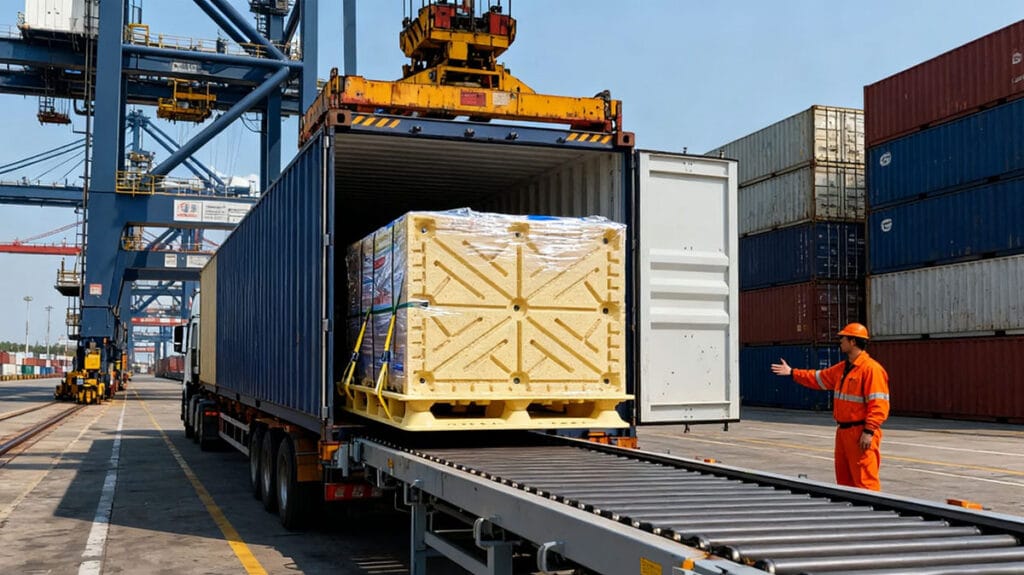
A Stackable pallet is designed to support stable vertical storage when loaded or empty pallets need to be arranged in layers. In warehouses, manufacturing facilities, distribution centers, and logistics operations, this can help businesses use available floor space more efficiently while maintaining organized material flow.
However, successful pallet stacking depends on more than whether one pallet can physically sit on top of another. Load distribution, pallet structure, cargo shape, support points, stacking height, forklift handling, and storage conditions all influence stability.
For this reason, stackability should be evaluated as part of the complete unit-load system. The pallet, cargo, packaging, handling equipment, and storage environment need to work together rather than being considered separately.
What Is a Stackable Pallet?
A Stackable pallet is a pallet designed so that loaded or empty units can be positioned vertically in a stable arrangement under suitable operating conditions.
The term may refer to two different situations. Empty pallet stacking focuses on storing unused pallets efficiently, while loaded pallet stacking involves placing one loaded pallet above another. These applications create different structural demands and should not be treated as identical.
For loaded pallets, the lower unit must support not only its own cargo but also forces created by the load above it. For empty pallets, dimensional consistency and support geometry become particularly important because several pallets may be stored together.
A properly selected pallet therefore needs to match the specific type of stacking used within the facility.
Why Stackability Matters in Warehouses
Warehouse space is limited, and floor area is often one of the most constrained resources in a logistics operation.
When pallets can be stored vertically under appropriate conditions, businesses can make better use of available cubic space instead of relying only on floor-level positions. This can be particularly useful in staging zones, production buffers, temporary storage areas, and empty-pallet storage locations.
Stackability can also support more organized material flow. When pallet dimensions and support structures remain consistent, warehouse teams can plan storage positions more predictably.
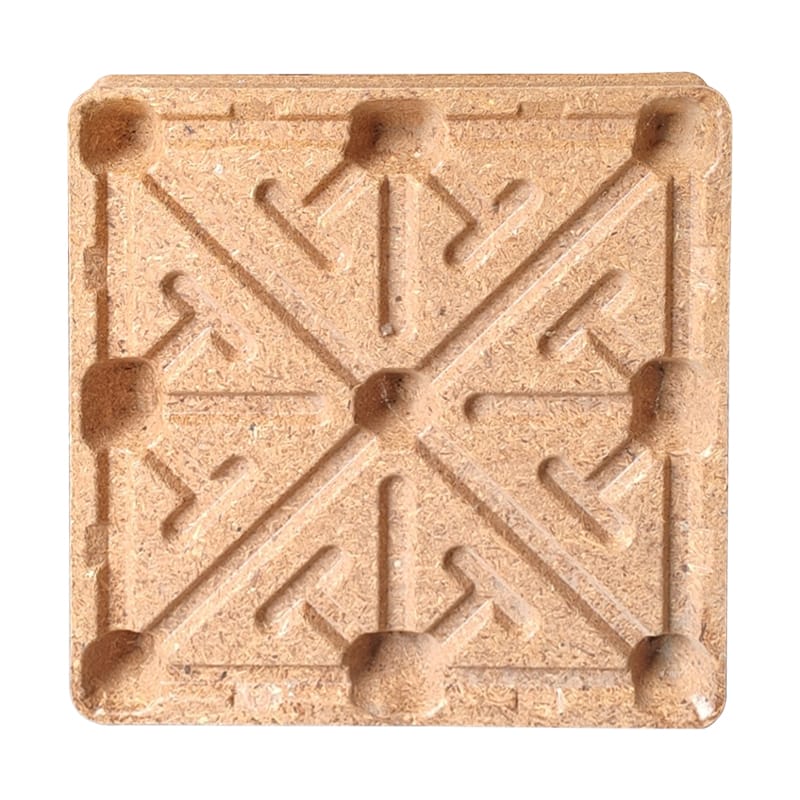
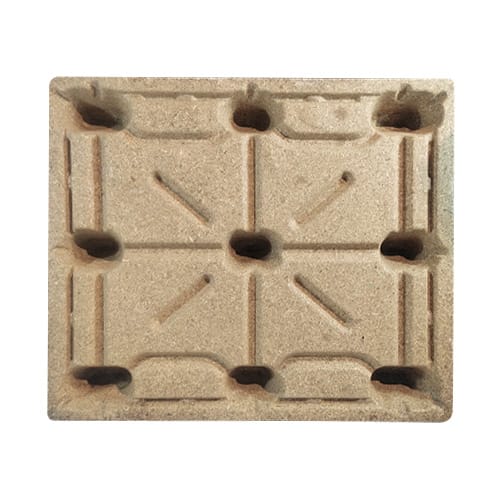
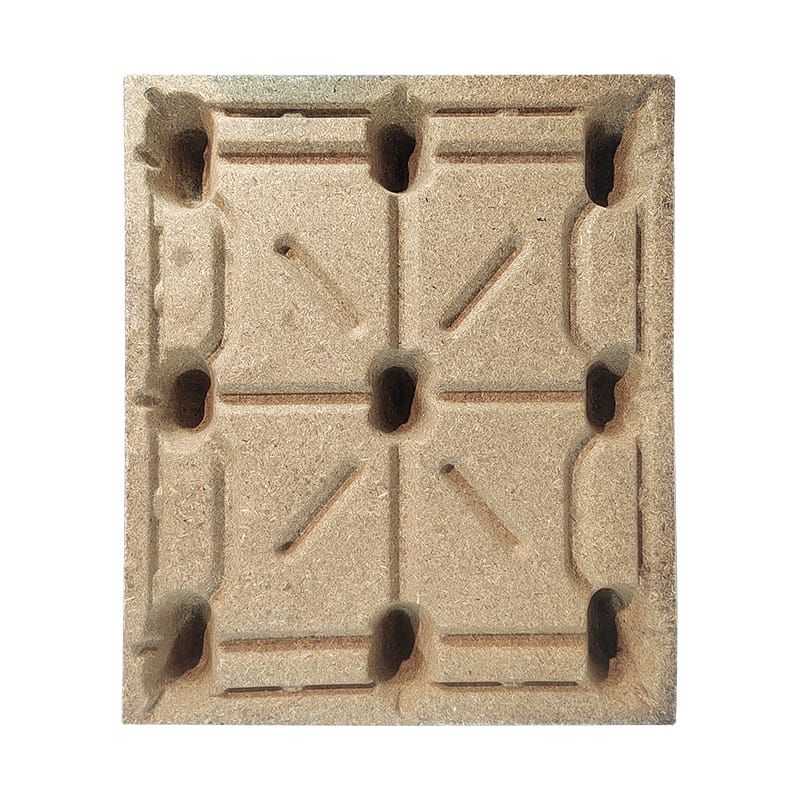
Xinyi’s current pallet product range includes molded and double-layer structures intended for warehousing, transportation, stacking, and other industrial handling applications.
Stackable Pallets and Unit Load Design
A pallet should not be evaluated independently from the goods placed on it.
In logistics, cartons, containers, pallet, securing materials, and handling equipment together form a unit load. The way these components interact influences overall stability during storage and movement.
The concept of a unit load explains how goods can be grouped on pallets for easier storage and handling and highlights the importance of considering packaging, pallets, equipment, and distribution conditions as one system.
This systems-based approach is especially relevant for stacked pallets because instability in any one component can affect the entire vertical load.
Load Distribution and Stacking Stability
Even load distribution is one of the most important considerations when stacking pallets.
Cargo positioned mainly in the center, concentrated along one edge, or supported at only a few points can create uneven stresses across the pallet deck. When another pallet is placed above it, these stresses may become more significant.
A stable load should distribute pressure through suitable support areas while maintaining a predictable center of gravity.
For cartons, this often means organizing packages so that the load footprint uses the pallet surface efficiently. For drums, machinery, bulk containers, or irregular goods, the contact pattern may require additional evaluation.
The total weight alone therefore does not determine whether stacking is suitable.
Static Load and Dynamic Load Are Different
Pallet performance should be evaluated according to how the load is being handled.
A pallet resting on a warehouse floor experiences static loading. The same pallet being lifted by a forklift experiences dynamic loading because the support points and forces change during movement.
Stacking introduces another condition because the lower pallet may need to support additional vertical pressure from the pallet above.
For this reason, logistics teams should not use one load figure for every operating condition. The pallet specification, load distribution, storage surface, handling method, and intended stacking arrangement should all be reviewed together.
Pallet Structure and Vertical Support
The design beneath the pallet deck has a major influence on stacking behavior.
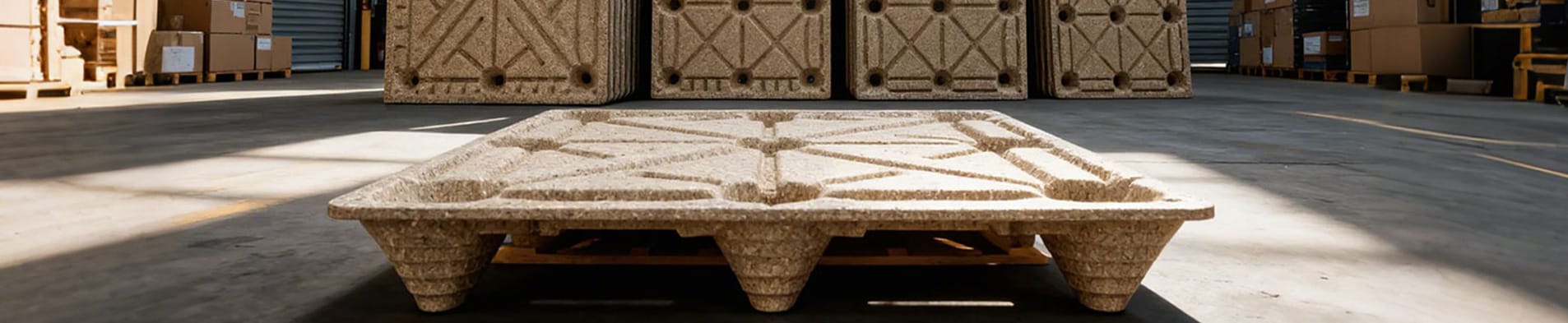
Supporting legs, runners, reinforced areas, and lower deck structures determine how vertical forces are transferred through the pallet. If the upper pallet applies pressure to unsupported areas, the lower pallet may experience unnecessary deformation.
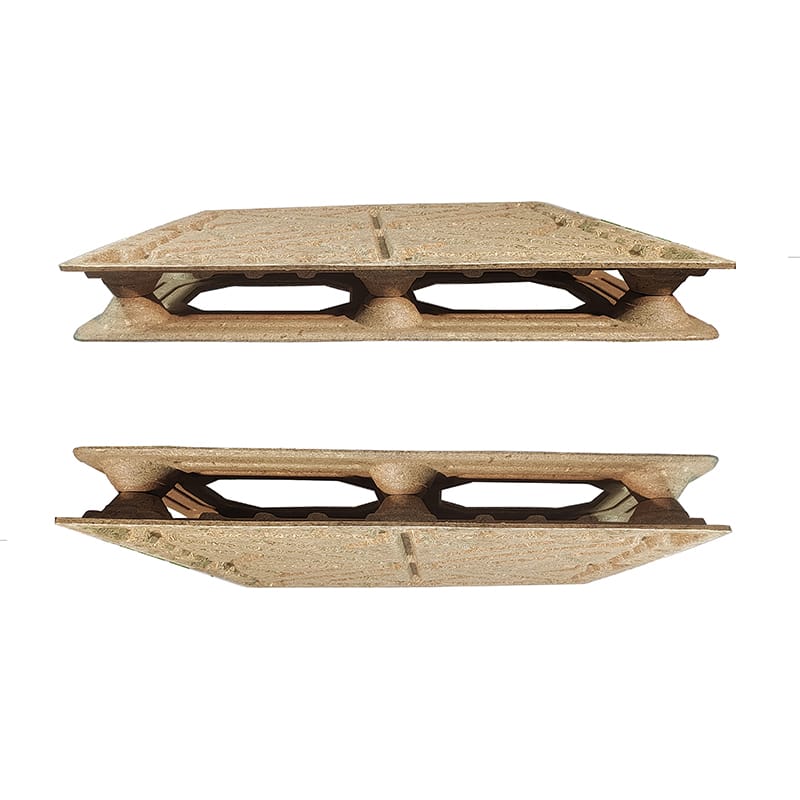
Double-layer pallet structures can provide defined support geometry for applications involving stacking or shelf use. For example, Xinyi’s double-layer compressed wood pallet uses separately molded deck and support sections assembled into an integrated structure for industrial handling and storage applications.
The correct structure still depends on the cargo and actual operating conditions rather than on the number of pallet layers alone.
Stackable vs Nestable Pallets
Stackable and nestable pallets are often discussed together, but they address different storage requirements.
A stackable pallet is arranged so one pallet can be positioned securely above another. A nestable pallet is designed so parts of multiple empty pallets fit inside each other, reducing the vertical space required for storage.
Nestability is mainly useful for empty-pallet storage and return logistics. Stackability can apply to empty pallets, loaded pallets, or both, depending on the design.
For warehouses, the choice should reflect actual workflows. Facilities with frequent empty-pallet accumulation may prioritize nesting, while operations storing palletized products vertically may focus more heavily on stacking stability.
Cargo Height and Center of Gravity
Stacking stability depends on what is above the pallet as much as what is below it.
Tall loads generally have a higher center of gravity and can become less stable during handling or when the supporting surface is uneven. Narrow cargo with significant height can create greater tipping risk than a lower, wider unit load.
The load should therefore be assessed by height, footprint, weight distribution, and center of gravity.
When several loaded pallets are stacked, these factors become increasingly important because instability can transfer through multiple layers.
Businesses should establish internal stacking limits based on the actual pallet and cargo combination rather than relying on a universal number of layers.
Carton Stacking Patterns
Carton arrangement has a direct effect on pallet load stability.
Boxes can be arranged in column, interlocking, or other stacking patterns according to carton strength and logistics requirements. The best pattern depends on how much vertical compression individual boxes can withstand and how the load will be transported.
Packages should normally remain within the pallet footprint where practical. Significant overhang can reduce support for the outer cartons and may expose packages to additional impact during handling.
At the same time, excessive unused deck area may indicate that the pallet size is poorly matched to the cargo.
A well-designed pallet load should therefore balance pallet utilization with package protection and vertical stability.
Forklift Handling of Stacked Pallets
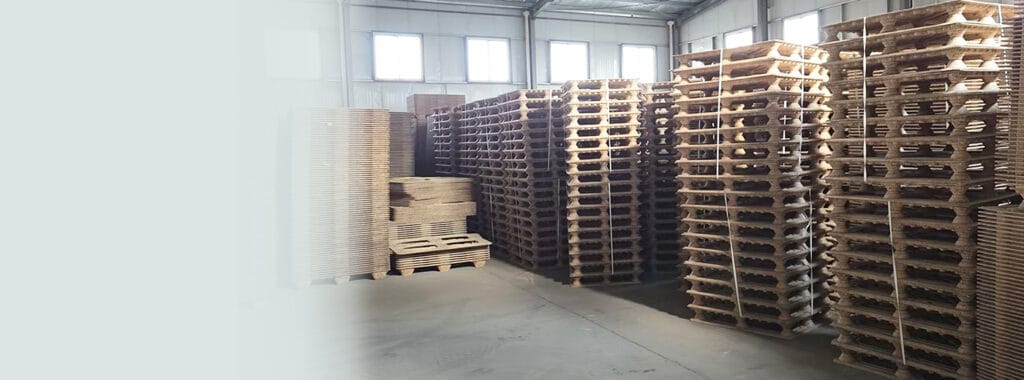
Forklift operations become more demanding when handling tall or stacked loads.
Operators need sufficient visibility, appropriate fork positioning, and adequate clearance around the pallet. Sudden acceleration, braking, or turning can shift the center of gravity and reduce stability.
Fork entry should also be unobstructed. Pallet geometry must allow forks to enter without striking support areas or damaging the lower structure.
Four-way entry can provide additional handling flexibility in facilities where pallets need to be approached from several directions, but operator practices remain important regardless of pallet design.
Warehouse procedures should define how stacked loads are lifted, moved, placed, and separated.
Floor Stacking vs Pallet Racking
Floor stacking and rack storage create very different pallet support conditions.
With floor stacking, the bottom pallet is normally supported across areas that contact the warehouse floor. Additional loaded pallets may then transfer vertical forces through the pallet structure.
In racking systems, support may occur only along selected beams or edges. This changes the way the pallet carries the load.
A pallet that performs well on a flat floor should therefore not automatically be assumed suitable for every rack configuration.
Before placing a pallet into racking, operators should verify the required support points, orientation, dimensions, load distribution, and compatibility with the specific rack system.
Empty Pallet Stacking
Empty pallets also require controlled stacking practices.
Although an empty pallet carries little cargo weight, tall stacks can become unstable when pallets are misaligned, damaged, or stored on uneven surfaces.
Consistent pallet geometry can help maintain alignment, but warehouse teams should still establish maximum stack heights appropriate to the pallet design and storage environment.
Empty pallet stacks should also remain clear of traffic routes where accidental forklift contact could create a hazard.
When the pallet structure allows compact stacking or nesting, storage areas can often be organized more effectively.
How Storage Conditions Influence Stackability
The warehouse environment can affect pallet condition over time.
Uneven floors can cause stacked pallets to lean. Moisture, contamination, repeated impacts, or unsuitable storage conditions can also affect the stability of a pallet system.
Before stacking, operators should inspect the storage location as well as the pallet itself.
A level surface, sufficient overhead clearance, appropriate distance from traffic routes, and adequate access for material-handling equipment all contribute to safer pallet storage.
For longer storage periods, the condition of both the pallet and the goods should be checked periodically.
Inspection Before Stacking
Damaged pallets should not be introduced into a stacked load without evaluation.
Inspection should focus on structural deformation, damaged support points, cracks, loose components, surface damage, and any condition that could prevent the upper pallet from sitting securely.
The upper surface should also be checked for obstructions or irregularities that could create unstable contact.
This is particularly important in repeated warehouse operations where the same pallets experience frequent forklift movements.
A simple inspection routine can prevent damaged pallets from becoming the weakest part of a vertical storage arrangement.
When Stackable Pallets Are Most Useful
Stackable pallets can be valuable in manufacturing facilities where finished products wait for outbound movement, in warehouses with temporary floor storage, and in distribution centers where palletized goods are staged before shipment.
They can also be useful in operations where empty pallets need to remain organized between loading cycles.
The benefit is greatest when pallet dimensions, load characteristics, storage layout, and handling procedures are predictable.
If cargo size changes constantly or loads have irregular centers of gravity, stacking may require additional controls and should be evaluated case by case.
How to Select a Stackable Pallet
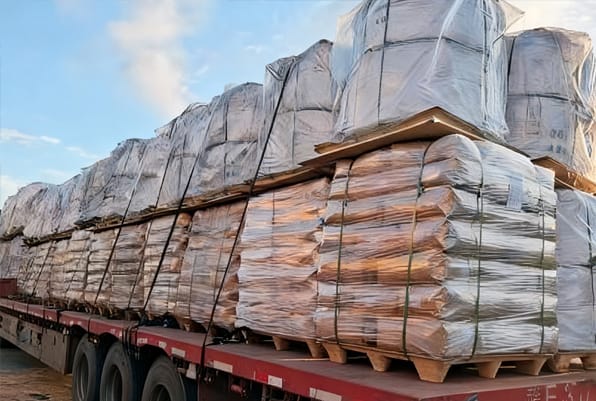
Selection should begin with the load rather than the pallet itself.
Determine cargo weight, footprint, height, center of gravity, packaging strength, and how pressure is distributed across the pallet deck. Then identify whether the pallet will be floor stacked, stored in racks, or used only for empty stacking.
The handling process should also be reviewed, including forklift type, entry direction, aisle width, lift height, and transfer frequency.
Finally, evaluate the pallet structure. Deck rigidity, support geometry, reinforcement, dimensional consistency, and contact areas between stacked units all affect practical performance.
A suitable Stackable pallet should therefore be selected as part of the complete warehouse and unit-load system.
Conclusion
A Stackable pallet can improve warehouse organization and support efficient use of vertical space, but successful stacking requires more than placing one pallet above another.
Cargo distribution, center of gravity, pallet structure, support geometry, forklift handling, storage surfaces, stacking height, and inspection practices all contribute to stability.
For warehouse and industrial applications, the most effective approach is to evaluate the pallet together with the goods, packaging, handling equipment, and storage environment. When these elements are properly coordinated, stackable pallet systems can provide a more organized and predictable material-handling process.
FAQ
What is a Stackable pallet?
A Stackable pallet is designed to allow pallets to be positioned vertically in a stable arrangement under suitable load and storage conditions.
What is the difference between stackable and nestable pallets?
Stackable pallets are designed to sit securely above one another, while nestable pallets allow empty units to fit partly inside each other to reduce storage volume.
Can loaded pallets be stacked?
Some pallets and loads can be stacked, but suitability depends on pallet structure, cargo weight, load distribution, packaging strength, stacking height, and operating conditions.
Can stackable pallets be used in pallet racks?
Only when the specific pallet design is compatible with the rack support configuration. Floor-stacking performance does not automatically confirm rack suitability.
What should be checked before stacking pallets?
Operators should inspect pallet condition, cargo stability, load distribution, floor level, available clearance, support alignment, and compatibility with handling equipment.
Need Help Evaluating a Stackable Pallet Structure?
Stacking requirements can vary significantly according to cargo weight, pallet structure, warehouse layout, forklift handling, and storage method. Explore Xinyi’s pallet product range to compare molded and double-layer configurations for warehouse, manufacturing, and logistics applications.