
Table of Contents
Introduction
A pallet is one of the simplest-looking components in a logistics system, yet its design can influence almost every stage of product handling. It supports cargo in storage, provides access for forklifts, helps organize warehouse space, allows multiple packages to move as a single unit, and can affect how efficiently goods are stacked or transported.
Because pallets are so common, they are sometimes selected almost automatically. A familiar size or material is chosen first, while questions about load distribution, storage method, handling equipment, and product footprint are considered later. For light and predictable applications, that approach may appear acceptable. In demanding industrial operations, however, it can lead to poor deck support, unnecessary pallet weight, inefficient warehouse use, or incompatibility with racks and conveyors.
The basic concept of a pallet is straightforward, but modern pallet selection requires more than identifying a flat platform beneath the cargo. Material, dimensions, deck design, supporting structure, load capacity, fork entry, storage conditions, and production consistency all contribute to actual performance.
This guide explains the main factors that should be considered when choosing pallets for manufacturing, warehousing, industrial shipping, material handling, and other logistics applications.
What Is a Pallet and Why Is It Important?
A pallet is a structural platform designed to support goods so that they can be handled as a unit by forklifts, pallet trucks, conveyors, or other material-handling equipment.
Its practical value comes from standardizing the interface between products and logistics equipment. Instead of moving cartons, containers, components, or bulk goods individually, the products can be assembled into a larger unit load that is easier to store and transfer.
However, the pallet itself carries structural responsibility. It needs to maintain adequate support while the unit load is stationary and while it is being moved. The way it performs can change depending on whether it is resting on a warehouse floor, being lifted by forklift blades, stacked above another load, or supported across rack beams.
This is why the same pallet should not automatically be assumed to have identical performance in every operating condition.
Main Types of Pallets Used in Industrial Logistics
There are many ways to classify pallets. Material, deck structure, fork-entry design, and lower support geometry are among the most useful distinctions.
Single-Deck Pallets
A single-deck pallet has one primary load-bearing deck with supporting legs, blocks, runners, or molded structures underneath.
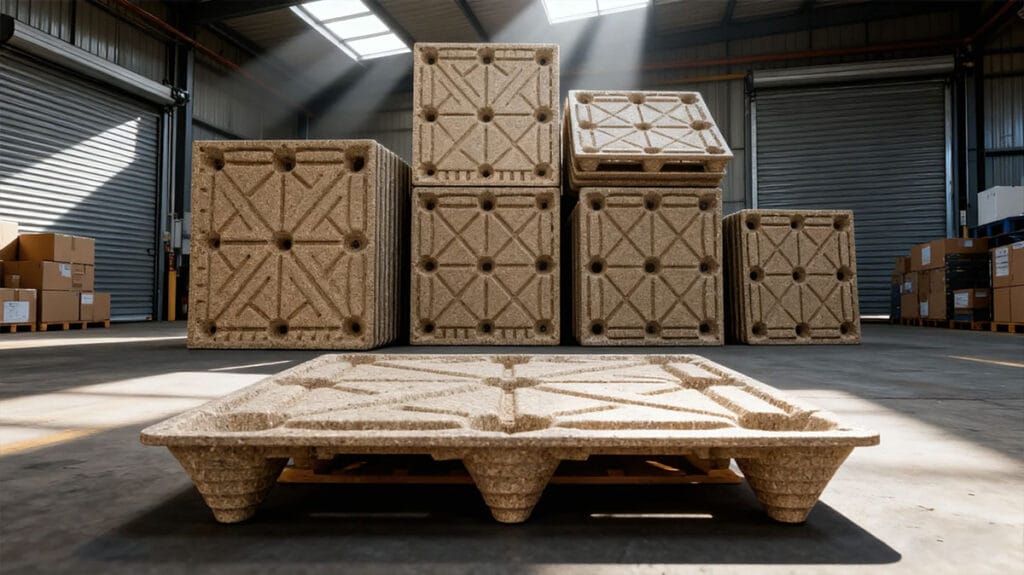
Depending on its design, this configuration can help reduce pallet tare weight and make empty storage more efficient. Some molded single-deck pallets can also nest, allowing several empty units to occupy less vertical space.
Single-deck construction can work well when the load, forklift configuration, and support conditions are properly matched to the structure.
Double-Deck Pallets
Double-deck pallets include an upper cargo deck and additional lower supporting geometry.
The lower structure can provide a broader or more controlled interface with floors, handling equipment, or other pallets. For heavier industrial applications, structural grids and reinforcing features may also improve the way forces are distributed through the pallet.
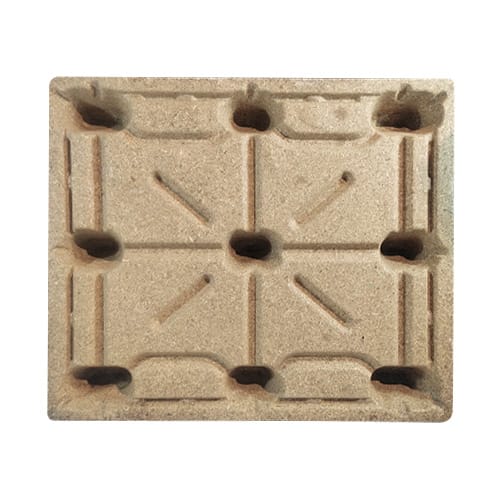
Xinyi Pallet’s double-deck square-grid pallets use molded structural geometry in multiple dimensions for industrial storage and material-handling applications.
A double-deck pallet is not automatically better than a single-deck design. Its suitability still depends on the cargo and the environment in which it will be used.
Pallet Materials and How They Affect Performance
Material is one of the first characteristics people notice, but choosing a pallet solely by material can be misleading. Two pallets made from similar raw materials can perform differently because their dimensions, reinforcement, manufacturing method, and structural geometry are different.
Traditional Wood Pallets
Traditional wooden pallets are usually assembled from boards, blocks, and runners using mechanical fasteners.
Their performance can be influenced by lumber properties, moisture condition, board thickness, joint design, runner spacing, fastener placement, and manufacturing consistency.
They can be produced in many configurations, which makes them suitable for a wide range of industrial applications.
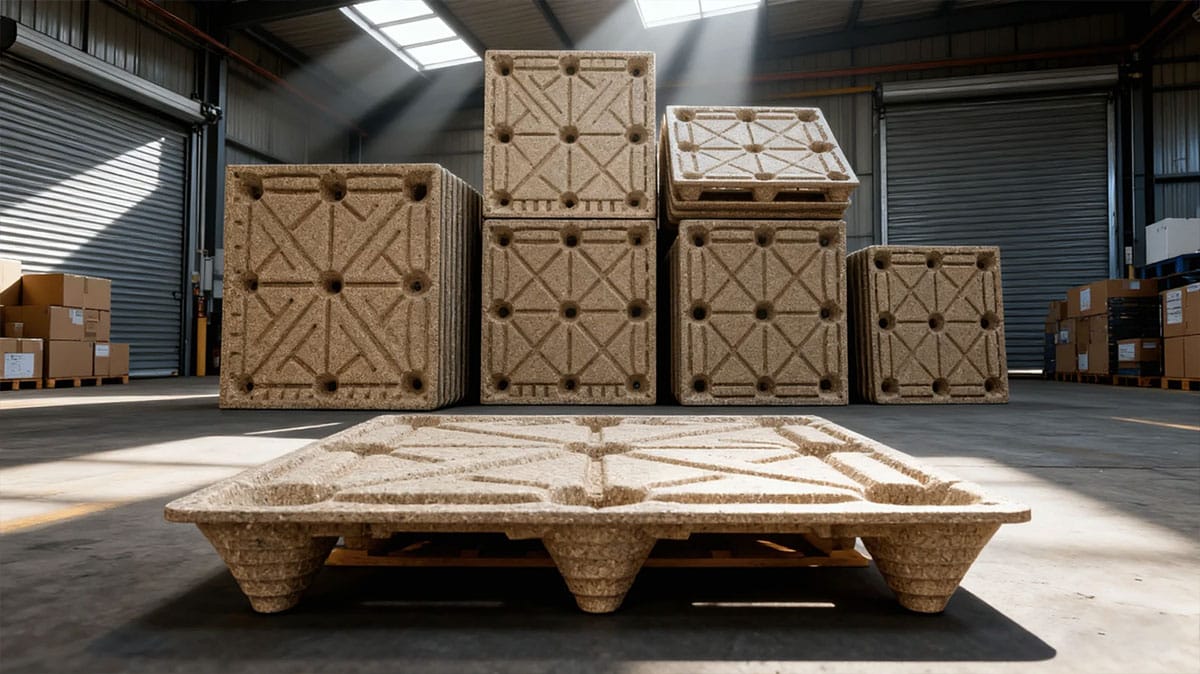
Molded Wood Pallets
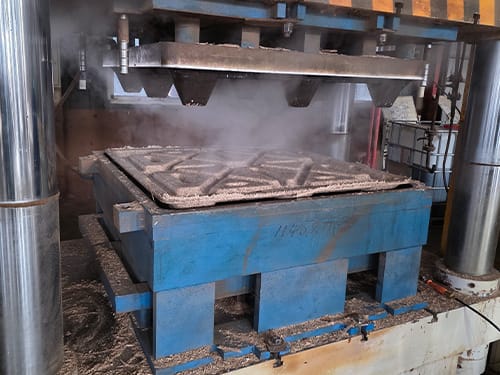
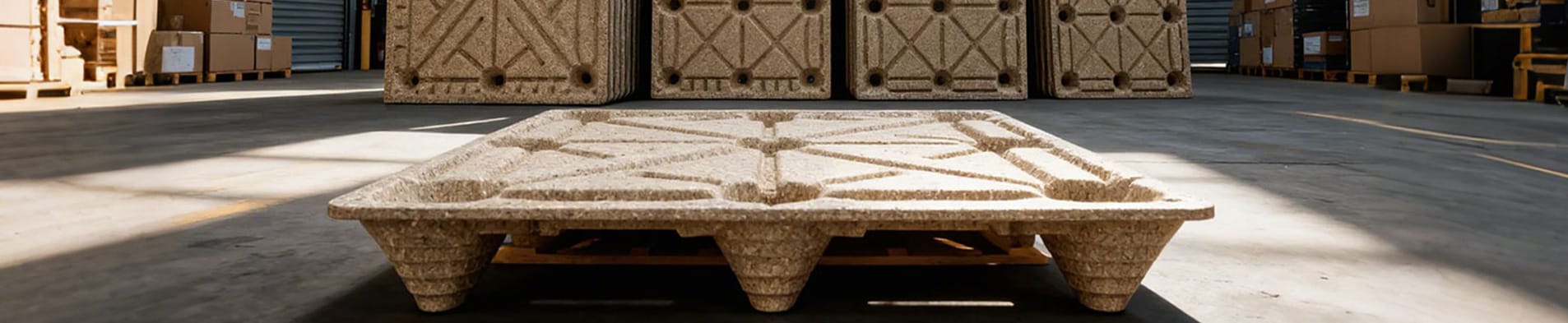
Molded wood pallets use processed wood fibers or other suitable plant-based materials that are formed under controlled conditions.
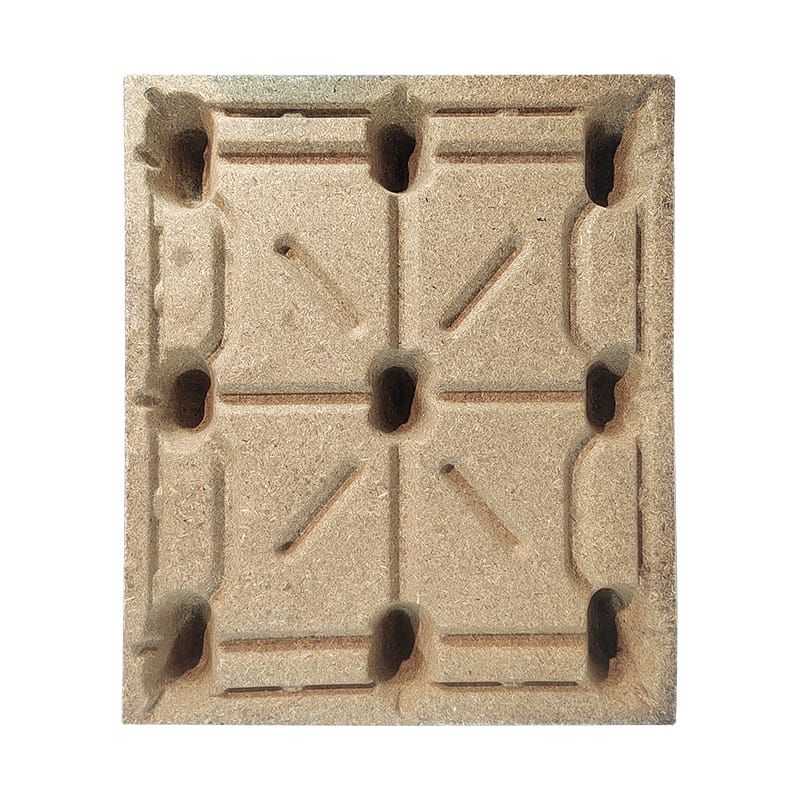
Rather than assembling individual boards, the manufacturing process can integrate the deck, legs, reinforcing ribs, and other structural features into a molded configuration.
For industrial applications, this approach can provide advantages where dimensional repeatability, integrated reinforcement, controlled geometry, or nestable empty-pallet storage is important.
The broader Xinyi guide to types of pallets explains how different structural formats can serve different warehouse and logistics requirements.
Plastic and Other Engineered Pallets
Plastic pallets can be useful where moisture resistance, dimensional consistency, cleaning, or repeated closed-loop use is important. Metal and other engineered pallets can serve specialized industrial environments.
The material should ultimately be selected according to load conditions, equipment compatibility, storage environment, handling frequency, and required structural behavior.
Understanding Pallet Load Capacity
Load capacity is often treated as the most important pallet specification, but it can also be one of the most misunderstood.
A capacity figure has limited meaning unless the support condition is clearly defined.
Static Load Capacity
Static loading describes a pallet carrying cargo while resting on a sufficiently supportive surface.
A warehouse floor usually supports a large portion of the lower pallet structure, allowing forces to be distributed through multiple load-bearing areas.
This generally creates a favorable condition compared with lifting or racking.
Dynamic Load Capacity
Dynamic loading becomes relevant when a pallet is lifted and moved.
Forklift blades support selected areas of the pallet instead of the entire base. Turning, acceleration, braking, vibration, and normal handling also introduce additional stresses.
For pallets moved frequently around manufacturing or warehouse facilities, dynamic performance is therefore especially important.
Racking Conditions
Rack storage creates another support condition.
Depending on the rack design, the pallet may bridge between beams while the center receives little or no direct support. The deck and lower structure must resist bending across this span.
A pallet with a high floor-supported load rating should not automatically be assumed to provide the same performance in rack storage.
Why Load Distribution Matters
Total cargo weight does not tell you exactly how the pallet will be stressed.
Imagine two loads with identical total weight. One consists of cartons arranged across most of the deck. The other is a machine supported by four narrow feet.
The carton load distributes pressure across a relatively broad area. The machine concentrates much of the same weight into four small contact points.
The second application may require reinforcement beneath those specific locations, even if the overall pallet capacity appears adequate.
Load distribution deserves particular attention for machinery, drums, bulk containers, sheet materials, tanks, heavy components, and other products that do not contact the deck evenly.
The center of gravity matters as well. Tall or uneven loads can behave differently during forklift turning and braking, even when the pallet itself remains structurally sound.
For complex industrial cargo, providing a manufacturer with product dimensions and contact-point information is more useful than supplying weight alone.
Pallet Structure and Load-Bearing Geometry
Pallet performance comes from the relationship between material and geometry.
The deck supports the product, while ribs, legs, runners, grids, or other lower structures transfer that load toward the floor or handling equipment.
Good structural design places support where it is actually needed.
Deck Support
A broad carton load may require relatively even deck support. A machine with several narrow feet may require stronger local support.
The deck should therefore be evaluated according to the actual product footprint rather than simply its overall surface area.
Reinforcing Ribs
Ribs can improve stiffness and help distribute loads through the pallet.
Their location is often more important than simply increasing the total amount of material used.
Efficient reinforcement can provide structural performance without making the entire pallet unnecessarily heavy.
Legs and Lower Supports
Supporting structures influence floor contact, forklift entry, nesting, racking, and load transfer.
Their position should correspond with both the pallet design and the equipment that will interact with it.
Choosing the Correct Pallet Dimensions
Pallet size should be selected around the product and logistics environment rather than habit alone.
Common industrial applications use both square and rectangular footprints, including configurations such as 1100 × 1100 mm, 1200 × 1000 mm, 1200 × 1100 mm, and other dimensions.
The correct size is the one that supports the load while fitting the surrounding system.
Product Overhang
When cargo extends beyond the pallet edge, part of the product loses direct deck support.
Overhang can also expose cartons or packaging to collisions with adjacent loads, handling equipment, or warehouse structures.
For repeatable industrial applications, minimizing unnecessary overhang generally improves load consistency.
Excessive Unused Deck Area
A pallet that is much larger than the product creates another inefficiency.
Unused surface occupies warehouse floor space, rack width, staging areas, and transportation capacity without supporting additional cargo.
Increasing pallet dimensions is therefore not automatically an improvement.
Overall Height
Height matters as well as length and width.
Pallet height influences fork entry, total loaded height, stacking efficiency, conveyor compatibility, and empty pallet storage.
For nestable pallets, the height added by each additional empty unit can also influence warehouse space requirements.
Pallet Size and Application Comparison
The following table shows how different operating conditions can change pallet selection priorities.
| Application | Primary Selection Concern | Pallet Features to Evaluate | Common Mistake |
|---|---|---|---|
| Carton storage | Product footprint | Deck coverage and dimensions | Allowing regular overhang |
| Heavy machinery | Concentrated loads | Local reinforcement and contact points | Selecting by total weight only |
| Bulk bags | Broad deck support | Load distribution and deck geometry | Ignoring bag contact area |
| Frequent forklift use | Dynamic handling | Entry clearance and structural rigidity | Looking only at static capacity |
| Rack storage | Unsupported span | Lower structure and rack compatibility | Assuming floor capacity equals rack capacity |
| Conveyor movement | Bottom geometry | Contact areas and dimensional consistency | Checking only forklift entry |
| Automated warehouse | Repeatability | Dimensions, orientation and tolerances | Accepting inconsistent geometry |
| Empty pallet storage | Space utilization | Nesting or stacking configuration | Considering loaded use only |
This comparison demonstrates why pallet selection should begin with the application rather than a catalog specification.
Forklift Compatibility and Pallet Entry Design

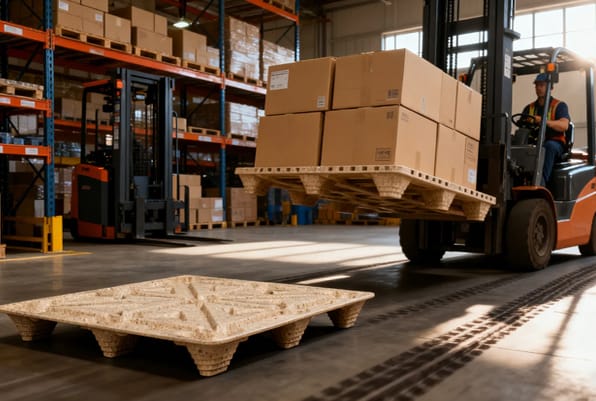
Forklifts are among the most common pieces of equipment interacting with pallets, so entry geometry has a direct effect on daily handling.
Two-Way Entry
Two-way entry limits forklift access to designated opposing directions.
It can work effectively in operations where pallet orientation remains predictable and movement is controlled.
Four-Way Entry
Four-way entry gives operators more options for approaching the pallet.
This can be helpful in warehouses, production facilities, staging areas, and loading environments where access direction changes frequently.
Neither configuration should be selected simply because one sounds more advanced. Workflow should determine the choice.
Fork Clearance
The openings also need sufficient height and width.
Repeated contact between forklift blades and pallet legs, ribs, or deck sections can gradually damage the structure. A technically adequate opening that offers very little operational clearance may still create unnecessary handling difficulty.
Fork thickness, spacing, approach angle, and pallet clearance should therefore be reviewed together.
Pallets for Warehouse Storage and Racking
Warehouse operations may place pallets on floors, stack them directly, place them in racks, or move them through several storage methods during one working cycle.
Floor storage usually provides broad lower support.
Racking can provide much less.
A pallet intended for rack use should therefore be evaluated according to beam position, orientation, unsupported span, cargo distribution, and expected storage duration.
Stacking loaded pallets introduces additional forces as well. The lower pallet may carry the weight of one or more loaded units above it, while upper pallet supports may transfer pressure through specific areas.
Stable stacking depends on both pallet structure and packaging strength.
Pallets for Conveyors and Automated Systems
Automation is making pallet consistency increasingly important.
A forklift operator can usually compensate for small variations manually. Automated systems often depend on more predictable dimensions and contact surfaces.
For conveyor applications, consider the pallet’s:
- bottom support geometry
- direction of travel
- contact with rollers or chains
- overall flatness
- dimensional consistency
Automated storage systems may also rely on predictable pallet height, length, width, entry openings, and orientation.
This means manufacturing tolerance becomes part of operational performance.
A pallet can be structurally strong yet still be unsuitable for automation if its geometry is inconsistent with the equipment.
Pallet Weight and Structural Efficiency
A pallet needs adequate strength, but unnecessary weight can become an operational disadvantage.
The pallet itself is part of every unit load. Additional tare weight is lifted by forklifts, carried by conveyors, supported by racks, and moved throughout the logistics system.
Good pallet design therefore aims for structural efficiency rather than simply maximum mass.
This means placing material where it contributes to deck stiffness, concentrated load support, fork-entry strength, or lower structural stability.
A heavier pallet is not automatically a stronger pallet under every condition. Structural geometry determines how effectively the material is used.
Empty Pallet Storage Should Not Be Ignored
Pallets spend part of their working life without cargo.
In large warehouses, empty pallet storage can occupy considerable floor and vertical space.
Stackable pallets can be placed directly above one another, while some molded designs are nestable. Nesting allows supporting elements to fit partially into the pallet below, reducing the space occupied by a group of empty units.
This can be valuable in operations where pallets accumulate in staging areas or are stored before production runs.
However, nesting should remain a secondary consideration. Loaded performance must still come first.
Selecting Pallets for Industrial Shipping
Pallets used in extended distribution cycles may experience more varied conditions than pallets used only within one warehouse.
Repeated transfers, vibration, stacked storage, environmental changes, and different handling equipment can all influence performance.
For industrial shipping, consider whether the pallet will encounter:
- repeated forklift movement
- extended loaded storage
- humidity changes
- temporary staging
- multiple loading and unloading operations
- different warehouse systems
Material processing and documentation may also become relevant depending on the pallet construction and intended logistics application.
Rather than selecting a pallet only for the first loading stage, evaluate whether it remains suitable throughout the intended handling cycle.
How Pallet Manufacturing Affects Performance
Manufacturing consistency has a direct influence on how predictable pallets are in use.
Traditional wooden pallets depend on factors such as lumber dimensions, moisture condition, joint construction, and fastener consistency.
Molded pallets depend on raw material preparation, material distribution, forming conditions, mold geometry, and dimensional control.
Neither process should be judged solely by appearance.
For industrial operations, meaningful quality characteristics include:
- dimensional accuracy
- consistent fork openings
- repeatable support geometry
- stable pallet weight
- surface condition
- structural integrity
- appropriate load verification
The more automated or repetitive the application becomes, the more valuable manufacturing consistency is.
When Does a Custom Pallet Make Sense?
Custom pallet design is worthwhile when standard configurations create a recurring operational problem.
One example is an unusual product footprint that consistently creates overhang. Another is a machine with concentrated contact points that do not align with the structural supports of an existing pallet.
Custom design can also be useful where conveyors, racks, or automated systems require specific geometry.
Depending on the manufacturing method, customization may involve:
- external length and width
- overall height
- deck configuration
- supporting-leg location
- reinforcing ribs
- fork-entry dimensions
- lower grid geometry
- nesting configuration
Customization should solve a measurable logistics or structural issue rather than simply make the pallet different from a standard design.
What Information Should You Provide to a Pallet Manufacturer?
A manufacturer can provide a better recommendation when the application is described clearly.
For an industrial pallet project, useful information includes the complete loaded weight, product footprint, load distribution, major contact points, packaged height, required fork-entry direction, storage method, rack configuration, conveyor use, stacking requirements, handling frequency, and expected environmental conditions.
For machinery or irregular cargo, photographs or simple drawings showing where the product contacts the deck can be particularly useful.
This allows structural decisions to be based on real loading conditions rather than general assumptions.
Common Pallet Selection Mistakes
One of the most common mistakes is choosing a pallet from its static load rating without considering how it will be handled. The same structure behaves differently on a floor, on forklift blades, and across rack beams.
Another mistake is choosing a larger pallet simply because the cargo is heavy. Increasing the footprint does not necessarily improve support if the actual load remains concentrated in poorly supported areas.
Material can also receive too much attention. Asking whether wood, molded wood, or another material is “best” without first defining the load and equipment usually produces an incomplete comparison.
Dimensions deserve similar caution. A widely used footprint can still be inefficient when it creates regular cargo overhang or large amounts of unused deck area.
Finally, empty pallet handling is often forgotten. In high-volume facilities, stacking, nesting, tare weight, and storage footprint can influence daily warehouse efficiency even though none of these characteristics directly increase loaded capacity.
A Practical Pallet Selection Framework
Before choosing a pallet, first define the load. Determine its complete weight, dimensions, contact points, center of gravity where relevant, and packaging arrangement.
Next, define how the pallet will be supported. Floor storage, forklift movement, racks, stacking, and conveyors each create different structural conditions.
Then evaluate the surrounding equipment. Fork spacing, entry clearance, conveyor contact areas, rack dimensions, and automated handling requirements should be known before the final pallet geometry is approved.
Only after these conditions are clear should material, structure, dimensions, and pallet weight be finalized.
This approach avoids treating the pallet as an isolated component. It becomes part of a broader material-handling solution designed around the actual product and operation.
Conclusion
Choosing the right pallet requires more than comparing materials, dimensions, or maximum load figures.
A good pallet needs to fit the cargo, distribute loads effectively, work with forklifts and warehouse systems, provide appropriate support during storage, and maintain predictable geometry throughout its intended operating cycle.
Static, dynamic, and racking conditions should be considered separately. Product contact points need to be understood, especially for heavy or irregular cargo. Dimensions should support the product without creating unnecessary overhang or unused deck space.
Material is important, but structure and manufacturing consistency are equally significant. Traditional wooden pallets, molded wood pallets, plastic pallets, and other designs can each be appropriate when their characteristics match the real application.
The most reliable selection process begins with the load and the logistics environment. Once those requirements are clear, pallet material, dimensions, deck design, support geometry, and handling configuration can be chosen with much greater confidence.
FAQ
What is a pallet used for?
A pallet provides a stable platform for storing, handling, and transporting goods as a unit load. It allows forklifts, pallet trucks, conveyors, and other equipment to move multiple products together while supporting the cargo during warehouse storage and industrial logistics operations.
How do I choose the right pallet?
Start with the complete cargo weight, footprint, load distribution, and contact points. Then consider forklifts, rack storage, stacking, conveyors, dimensions, and environmental conditions. Choose the pallet structure and material only after these operating requirements are clearly defined.
How much weight can a pallet hold?
Pallet capacity depends on material, structural geometry, dimensions, load distribution, and support conditions. A pallet can have different static, dynamic, and racking capabilities, so a single maximum-load number should not be assumed to apply to every storage and handling situation.
What is the difference between single-deck and double-deck pallets?
Single-deck pallets use one primary load-bearing deck with supporting elements underneath, while double-deck designs include additional lower structural geometry. The better option depends on the cargo, handling equipment, storage method, stacking requirements, and required pallet stability.
Are molded wood pallets suitable for industrial use?
Molded wood pallets can be suitable for industrial applications when their load capacity, dimensions, structural geometry, fork entry, and support configuration match the operation. Integrated molded ribs and supporting areas can also provide repeatable geometry for warehouse and logistics use.