
Table of Contents
Introduction
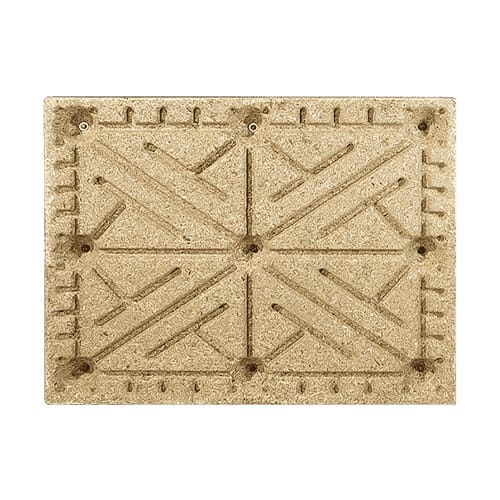
An industrial pallet may look like a simple load platform, but in manufacturing, warehousing, export logistics, and material handling, it performs a structural job every time goods are stored, lifted, moved, stacked, or transferred.
That is why selecting an industrial pallet only by dimensions or a maximum load figure can create problems later. A pallet that performs well on a warehouse floor may behave differently when supported by forklift forks or rack beams. A design that works for evenly distributed cartons may not be suitable for machinery, bulk bags, tanks, or other concentrated loads.
In professional logistics, the pallet should be considered together with the complete unit load. Unit-load design considers the relationship between packaging, the pallet, handling equipment, and the distribution environment rather than evaluating each element in isolation.
For most industrial applications, seven factors deserve particular attention:
- Actual load characteristics
- Static, dynamic, and racking requirements
- Pallet structure
- Material and manufacturing consistency
- Forklift and warehouse compatibility
- Pallet dimensions and space utilization
- Storage, export, and operating conditions
Looking at these factors together gives you a much stronger basis for choosing an industrial pallet that will work reliably in everyday operations.
1. Start With the Load the Industrial Pallet Will Actually Carry
The first question should not be “What is the strongest pallet?”
It should be “What exactly are we putting on it?”
Two industrial loads with the same total weight can require very different pallet structures because weight distribution has a major influence on stress.
Distributed Loads
Cartons, packaged components, bagged materials, and similar goods can often spread their weight across a large portion of the deck.
When contact is relatively uniform, several structural areas of the industrial pallet share the load.
That does not remove the need for adequate strength, but it generally creates a more predictable loading condition.
Concentrated Loads
Industrial machinery, drums, containers, dense components, and equipment with feet can transfer most of their weight through a relatively small contact area.
This creates localized stress.
For example, a machine resting on four narrow supports does not load the pallet in the same way as a full layer of cartons, even when both loads have identical total weight.
In concentrated-load applications, deck thickness alone may not solve the problem. Support geometry beneath the contact points can be equally important.
Irregular Loads
Some loads combine several challenges:
- uneven weight distribution
- high center of gravity
- irregular footprint
- limited contact area
- unstable packaging
- protruding components
For these applications, the industrial pallet should be selected around the actual unit-load arrangement rather than a general cargo category.
A drawing showing product dimensions and contact areas is often more useful to a pallet manufacturer than simply providing total weight.
2. Understand Industrial Pallet Load Capacity Correctly
“Load capacity” is one of the most misunderstood pallet specifications.
The number only becomes meaningful when you know how the pallet is supported.
Static Load
Static load describes conditions where the industrial pallet remains stationary on a sufficiently supportive surface.
Floor storage normally provides more continuous support beneath the pallet, so stress can be distributed across a wider part of the lower structure.
Static capacity is useful, but it should never be the only capacity used to evaluate an industrial application.
Dynamic Load
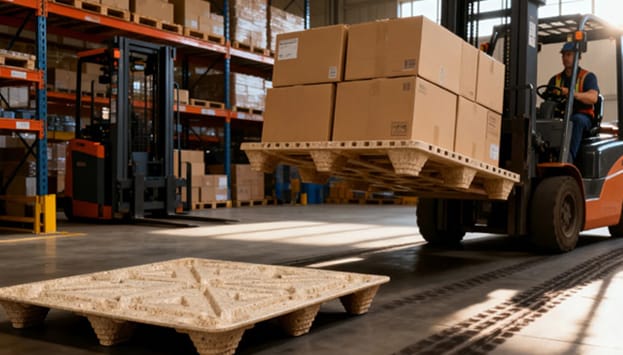
Dynamic loading occurs when a loaded pallet is lifted and moved.
Forklift forks support only selected portions of the pallet, while acceleration, braking, turning, vibration, and normal handling introduce additional forces.
This is why an industrial pallet that appears completely stable while sitting on the floor may behave differently once lifted.
For operations involving frequent internal transfers, dynamic performance deserves particular attention.
Racking Conditions
Rack storage introduces another structural situation.
Depending on rack design, support may be provided primarily along specific beams. Sections of the pallet can remain unsupported, increasing bending stress across the span.
Before using an industrial pallet in racking, confirm:
- rack support positions
- beam spacing
- direction of pallet placement
- load distribution
- expected storage duration
- maximum loaded weight
Do not assume that a static capacity automatically represents rack performance.
The Better Question to Ask
Instead of asking:
“How much weight can this industrial pallet hold?”
Ask:
“What load can this pallet support under my specific floor, forklift, stacking, or rack condition?”
That small change produces a much more useful technical answer.
3. Evaluate Industrial Pallet Structure, Not Just Material
Material receives a lot of attention during pallet selection, but structure often determines whether that material is being used effectively.
The deck, ribs, legs, runners, grids, edges, and lower supports all affect how the industrial pallet responds to a load.
Single-Deck Structures
Single-deck configurations can be useful when applications prioritize:
- lower tare weight
- nesting
- empty pallet storage
- straightforward forklift handling
Their suitability for a particular load depends on the geometry of the deck and supporting elements.
Double-Deck Structures
A double-deck industrial pallet introduces additional lower structural elements.
Depending on its design, this may improve stability or provide a different load-transfer pattern during handling and storage.
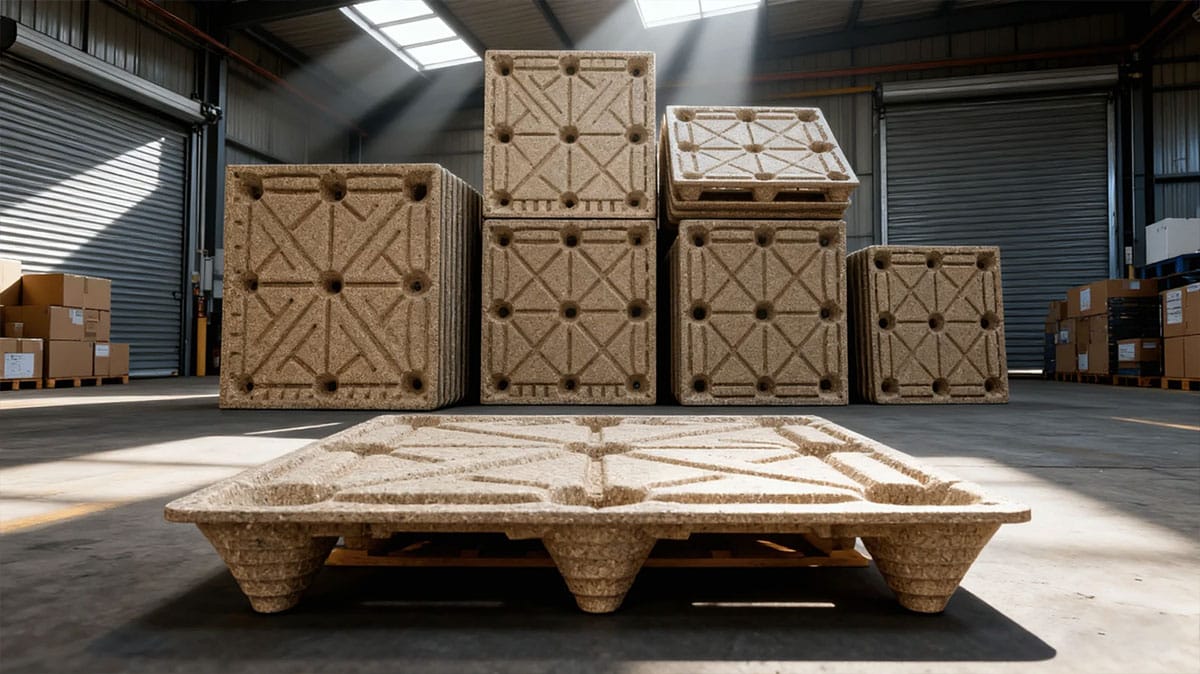
Xinyi’s double-deck square grid pallet range uses molded construction with integrated grid geometry and is positioned for manufacturing, warehousing, logistics, and other industrial applications.
The important point is not that double-deck construction is always better. It is that the lower structure must fit the way the pallet will actually be supported.
Ribs and Reinforcement
Good reinforcement is strategic rather than excessive.
Adding material everywhere can increase pallet weight without addressing the most highly stressed areas.
A better design places structural support where forces are most likely to occur, such as:
- beneath concentrated cargo
- around fork-entry zones
- between major supports
- around legs or runners
- near corners exposed to handling impacts
This is one reason molded industrial pallet design can be interesting from an engineering perspective: structural geometry can be integrated into the forming process rather than assembled only from separate boards.
4. Choose the Material According to the Operating Environment
An industrial pallet may be made from traditional timber, molded plant-fiber material, plastic, metal, or other engineered materials.
Material choice should follow the application rather than personal preference.
Traditional Wood
Traditional wooden pallets are familiar across many industrial sectors and can be manufactured in numerous configurations.
Performance can be influenced by:
- lumber condition
- moisture
- board thickness
- fasteners
- joints
- runner design
- production tolerances
For specialized industrial loads, these variables need to be considered as part of the complete pallet specification.
Molded Wood and Plant-Fiber Pallets
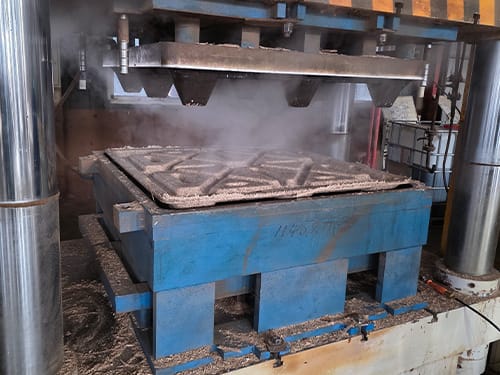
Molded pallet production can use processed plant fibers formed under controlled pressure and heat.
The resulting industrial pallet can incorporate the deck and supporting geometry into an integrated structure.
Potential characteristics relevant to industrial logistics include:
- consistent molded geometry
- integrated reinforcement
- nestable configurations
- controlled dimensions
- elimination of conventional board-and-nail construction
However, the word “molded” by itself does not guarantee suitability for every load.
Actual pallet design and operating conditions still matter.
Plastic and Other Materials
Plastic pallets may be useful where dimensional consistency, moisture exposure, or cleaning requirements influence selection.
Metal structures can serve highly specialized applications where different strength or durability characteristics are required.
Rather than asking which material is universally best, consider five questions:
- How heavy and concentrated is the load?
- How frequently is the pallet handled?
- Where will it be stored?
- What dimensional consistency does the system require?
- Is the pallet intended for one-way distribution, repeated circulation, or another operating model?
The answers narrow the material choice much more effectively than broad material comparisons.
5. Match the Industrial Pallet to Forklifts, Conveyors, and Storage Systems
A pallet is only useful if your equipment can handle it correctly.
This is especially important in industrial operations where the same pallet may interact with several different systems during one logistics cycle.
Forklift Entry
Consider both entry direction and physical clearance.
Important dimensions include:
- fork opening width
- fork opening height
- fork spacing
- distance between supporting elements
- pallet ground clearance
Repeated contact between forklift blades and pallet legs or structural ribs can shorten useful service life even when the pallet itself has sufficient load capacity.
Two-Way and Four-Way Entry
Four-way access can improve handling flexibility where operators frequently approach loads from different directions.
Two-way access may still be completely appropriate in controlled workflows.
The better option depends on warehouse layout, pallet orientation, aisle width, equipment type, and handling frequency.
Conveyor Compatibility
An industrial pallet intended for conveyor systems needs predictable contact with rollers, chains, or other supporting mechanisms.
Check:
- bottom-surface geometry
- support spacing
- pallet flatness
- direction of travel
- dimensional tolerances
- transfer points between conveyor sections
A pallet designed only around forklift handling may not automatically work well on a conveyor.
Automated Handling
Automation makes repeatability increasingly important.
Systems may depend on pallets arriving with consistent:
- dimensions
- entry openings
- bottom geometry
- orientation
- deck position
- structural shape
Small variations that are insignificant in manual handling can become more noticeable in automated operations.
6. Select Industrial Pallet Dimensions Around the Product
Standardized pallet sizes can simplify logistics, but product dimensions should still influence the final decision.
An industrial pallet that is unnecessarily large consumes usable space. One that is too small may leave products unsupported.
Avoid Excessive Overhang
Cargo extending beyond the pallet edge is more exposed to:
- collision
- crushing
- packaging deformation
- unstable stacking
- contact with neighboring loads
Overhang may also shift load forces toward deck edges that were not intended to carry concentrated pressure.
Avoid Excessive Underhang
Too much unused deck area creates a different kind of inefficiency.
A pallet footprint significantly larger than the cargo can reduce:
- warehouse storage density
- transport utilization
- staging efficiency
- available handling space
The optimum industrial pallet is therefore not necessarily the largest pallet that fits your operation.
It is the size that supports the product correctly while fitting the surrounding logistics system.
Think About Product Arrangement
Sometimes pallet efficiency can be improved without changing the pallet itself.
Review:
- carton orientation
- number of units per layer
- number of layers
- spacing between items
- load height
- location of heavy components
Changes in product arrangement can alter load distribution and improve deck utilization.
7. Consider Storage Efficiency and Empty Pallet Handling
The loaded pallet receives most of the attention during specification, but industrial operations also need to manage pallets when they are empty.
That can become significant in facilities handling large pallet volumes.
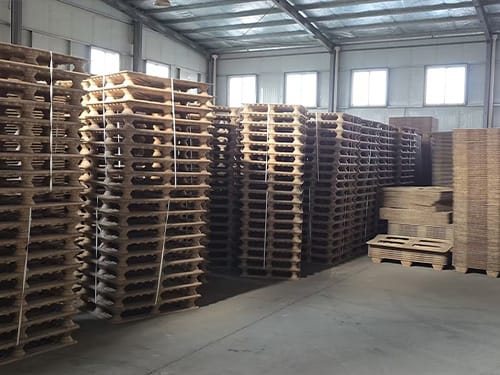
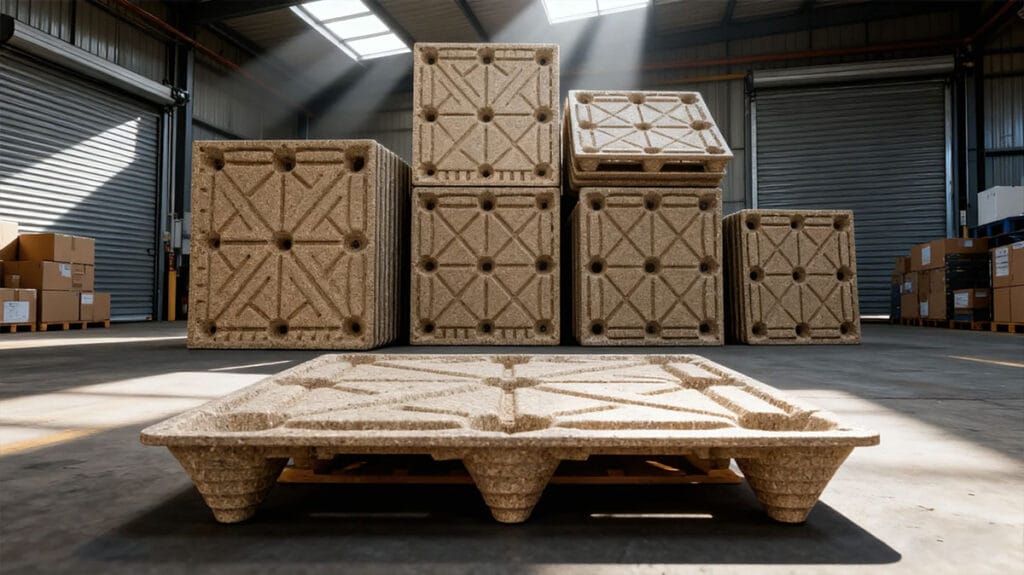
Nestable Industrial Pallets
Some molded designs allow pallets to fit partially inside one another when empty.
This can reduce the space needed for:
- warehouse storage
- staging areas
- internal movement
- empty pallet handling
Nesting is especially useful when empty pallets occupy significant floor area.
However, nesting should remain a secondary selection criterion. Loaded performance comes first.
Stackable Pallets
Stackability refers to how pallets sit on one another rather than nesting deeply together.
A stable stack can simplify empty-pallet storage, but the structure should remain predictable enough for safe handling.
Pallet Tare Weight
Industrial pallet weight also deserves consideration.
An unnecessarily heavy pallet becomes part of every loaded handling event. Forklifts, conveyors, storage systems, and personnel all interact with that additional mass.
Structural efficiency is therefore preferable to simply adding more material.
8. Compare Industrial Pallets by Operating Requirement
Different applications place different demands on an industrial pallet.
| Operating Requirement | Main Pallet Factor | What to Evaluate | Common Selection Mistake |
|---|---|---|---|
| Heavy carton loads | Deck support | Load distribution and deck coverage | Selecting only by total weight |
| Machinery | Local reinforcement | Contact points and center of gravity | Ignoring concentrated loads |
| Bulk bags | Deck geometry | Bag support and load stability | Using insufficient support area |
| Containers or tanks | Structural stability | Contact pattern and movement | Assuming all heavy pallets behave alike |
| Frequent forklift handling | Dynamic performance | Fork entry and impact zones | Checking static load only |
| Rack storage | Unsupported span | Rack-beam support and bending | Treating floor and rack loading equally |
| Conveyor handling | Bottom geometry | Contact surfaces and consistency | Checking only fork access |
| High-volume warehousing | Space efficiency | Dimensions, nesting, stacking | Ignoring empty pallet storage |
| Export logistics | Material and process | Documentation and operating requirements | Selecting only by pallet dimensions |
This comparison shows why “industrial pallet” should be treated as an application category rather than a single standardized product.
Two facilities can use pallets of the same dimensions and still require very different structures.
9. Industrial Pallet Design for Manufacturing and Warehousing

Industrial pallets frequently operate inside production facilities before they ever enter transportation.
That makes internal logistics an important part of pallet selection.
Production-Line Handling
If components move between production stages on pallets, consider how frequently each industrial pallet will be lifted and repositioned.
Repeated short movements can sometimes create more handling events than a long transportation journey.
Entry areas and supporting geometry therefore deserve attention.
Warehouse Storage
Warehouse conditions influence pallet design through:
- floor stacking
- rack storage
- pallet-flow systems
- staging areas
- forklift traffic
- automated handling
The existing Xinyi content on types of pallets also distinguishes several structural pallet formats used for different logistics and warehouse requirements.
The key is to choose the industrial pallet according to the storage system rather than forcing a warehouse process to adapt to an unsuitable pallet.
Product Protection
A pallet also helps protect cargo by keeping it supported and positioned during material handling.
Poor support can allow packaging to deform, while an unstable palletized load can shift during transfer.
For sensitive products, pallet design and packaging design should therefore be evaluated together.
10. Do Export Operations Change Industrial Pallet Requirements?
They can.
Export logistics may introduce longer handling cycles, multiple transfers, extended storage, humidity changes, and different packaging requirements.
A pallet used only for short internal warehouse movements does not necessarily face the same conditions as one used throughout a long distribution cycle.
Material Processing
When using wood-based packaging, confirm the exact material and manufacturing process rather than relying only on a general description such as “wood pallet.”
Processed wood-based products and conventional solid-wood structures may differ significantly in how they are manufactured.
Applicable shipment requirements should always be confirmed for the actual pallet and logistics route.
Environmental Exposure
Consider whether the industrial pallet may experience:
- elevated humidity
- temporary outdoor storage
- temperature fluctuations
- enclosed transport
- extended loading periods
These conditions may affect material selection and structural design.
Long Handling Cycles
A pallet can be loaded correctly at the beginning of a shipment but still encounter repeated impacts later.
Consider the complete handling cycle, including:
- warehouse pickup
- staging
- vehicle loading
- unloading
- temporary storage
- secondary handling
- final delivery
The more handling events involved, the more important structural consistency becomes.
11. What Should You Give an Industrial Pallet Manufacturer?
Good pallet selection depends heavily on the quality of information supplied to the manufacturer.
Simply requesting “a heavy-duty industrial pallet” leaves too many technical questions unanswered.
A useful specification should include:
- maximum total unit-load weight
- cargo length and width
- load height
- contact points with the pallet
- load distribution
- handling frequency
- forklift requirements
- storage method
- rack information if relevant
- conveyor requirements
- stacking conditions
- environmental exposure
- desired pallet dimensions
For complex products, photographs, drawings, or load-layout diagrams can add valuable context.
Ask About the Application, Not Only the Catalog
A technically useful discussion should address why a particular pallet structure is being recommended.
Questions worth asking include:
- Why is this deck design suitable for my load?
- Which areas carry the highest stress?
- What happens when the pallet is lifted?
- Is the structure suitable for rack storage?
- Can the dimensions be adjusted around my cargo?
- What production controls support dimensional consistency?
These questions are particularly useful when selecting customized industrial pallets.
12. A Practical Industrial Pallet Selection Checklist
Before confirming a pallet specification, review the following points.
Cargo
Is the maximum weight known?
Is the load evenly distributed?
Are there concentrated support points?
Does the cargo have an unusually high center of gravity?
Structure
Does the pallet deck support the actual product footprint?
Are the legs, ribs, runners, or lower supports positioned appropriately?
Is the design suitable for the required handling frequency?
Capacity
Have static and dynamic conditions been considered separately?
Will rack storage introduce unsupported spans?
Are stacking loads relevant?
Handling
Can the forklift enter without repeatedly striking structural areas?
Is two-way or four-way access required?
Will the industrial pallet interact with conveyors or automated equipment?
Dimensions
Does the cargo overhang?
Is there excessive unused pallet area?
Will the footprint work efficiently with the warehouse layout?
Environment
Will the pallet encounter moisture or prolonged storage?
Is dimensional consistency important?
Does the manufacturing process suit the expected distribution cycle?
A pallet that satisfies these questions is much more likely to perform consistently than one selected from dimensions and nominal load capacity alone.
Conclusion
Choosing an industrial pallet is fundamentally a systems decision.
The pallet needs to match the cargo, but it also needs to match forklifts, warehouse storage, racks, conveyors, transport conditions, and the expected handling cycle.
Start by understanding the real load. Determine whether it is distributed or concentrated, how it contacts the pallet, and what happens when the load moves. Then evaluate capacity under the support conditions that will actually occur.
Material should come after those questions rather than before them.
Traditional wood, molded plant-fiber structures, plastic, and other materials can each have appropriate industrial applications. What matters is whether the complete pallet design provides the required structural support, dimensional consistency, handling compatibility, and storage efficiency.
A well-selected industrial pallet does more than carry weight. It makes material handling more predictable, helps use warehouse space efficiently, supports product protection, and integrates more naturally with the rest of the logistics operation.
FAQ
What is an industrial pallet?
An industrial pallet is a load-bearing platform intended for manufacturing, warehousing, material handling, storage, or distribution applications. The appropriate design depends on cargo weight, load distribution, forklifts, racks, conveyors, stacking conditions, and the operating environment.
How do I choose the right industrial pallet?
Start with the complete load rather than pallet material alone. Check cargo weight, contact points, static and dynamic requirements, storage method, forklift entry, dimensions, and environmental conditions. The pallet structure should then be matched to those real operating requirements.
How much weight can an industrial pallet hold?
There is no single capacity that applies to every industrial pallet. Performance varies with structure, material, dimensions, load distribution, and support condition. Static floor loading, forklift handling, and rack storage should be evaluated separately before confirming suitability.
Are molded wood pallets suitable for industrial use?
Molded wood pallets can be suitable for industrial applications when their structural geometry, dimensions, load characteristics, and handling configuration match the operation. Their integrated molded structure can also support consistent geometry and different deck or support designs.
What size industrial pallet should I choose?
Choose a size that adequately supports the cargo while limiting unnecessary overhang or unused deck area. Also consider warehouse racks, forklift access, conveyors, stacking arrangements, and transport utilization. A standard size is useful only when it fits the complete logistics system.