
Table of Contents
Introduction

Pallet transport is a basic part of industrial logistics, but reliable movement depends on much more than placing products on a pallet and lifting the load with a forklift. The pallet has to support the cargo during repeated handling, remain stable while the load accelerates or turns, fit warehouse and transport equipment, and maintain suitable structural support throughout storage and movement.
A pallet that performs well while resting on a warehouse floor may experience very different stresses when it is lifted, transferred, stacked, or transported for an extended period. Product weight may stay exactly the same, yet the way that weight acts on the pallet changes continually.
The general purpose of a pallet is to support goods as a unit that can be handled mechanically. For pallet transport, however, good performance depends on the relationship between the cargo, pallet structure, dimensions, load distribution, handling equipment, storage method, and surrounding logistics environment.
The key points to consider include:
- complete unit-load weight and distribution
- pallet dimensions and cargo footprint
- static and dynamic load requirements
- deck and lower support structure
- forklift-entry compatibility
- stacking and warehouse conditions
- load restraint and product stability
- repeated handling frequency
- pallet manufacturing consistency
- empty-pallet handling and storage
Considering these factors together helps create a pallet transport system that is more predictable from initial loading through warehouse handling and final unloading.
Why Pallet Transport Requires More Than Load Capacity
Load capacity is important, but it does not describe everything that happens during pallet transport.
A load-capacity figure usually applies under a defined support condition. If the pallet rests on a stable floor, much of its lower structure may receive support. Once a forklift lifts the same pallet, only certain areas are supported by the fork blades. During transport, vibration, turning, braking, and repeated handling create further demands.
This means a pallet cannot be selected only because its stated capacity exceeds the cargo weight.
The complete application should be considered. A pallet carrying evenly distributed cartons may behave differently from one carrying machinery with four concentrated contact points. The same pallet may also perform differently when stored on the floor, stacked with another loaded pallet, or placed across rack beams.
Reliable pallet transport begins by understanding those differences before the pallet configuration is finalized.
Cargo Weight Is Only the Starting Point
The first step is defining the complete unit load.
The weight should include the product and all packaging that remains on the pallet during handling. More importantly, the position of that weight should be understood.
An evenly distributed load spreads pressure across more of the deck. Cartons covering most of the pallet surface are a common example. A concentrated load transfers much of its weight through smaller areas. Machinery, drums, industrial containers, tanks, bulk materials, and equipment supported on legs can create this type of condition.
Two loads can therefore have identical total weight while creating significantly different structural demands.
Pallet transport becomes more challenging when the load is uneven or has a high center of gravity. During forklift movement, turning and braking can make an already unbalanced load less stable. The pallet may remain structurally intact while the complete unit load becomes difficult to handle safely and consistently.
For irregular industrial cargo, recording the product dimensions, contact locations, packaged height, and center of gravity can provide much more useful information than total weight alone.
How Load Distribution Affects Pallet Transport
Load distribution determines where stress enters the pallet structure.
When cartons are arranged over most of the deck, several parts of the pallet can participate in supporting the weight. With concentrated industrial equipment, the deck may receive most of the pressure in only a few locations.
This distinction influences the design of deck surfaces, ribs, runners, grids, legs, and other supporting components.
Increasing pallet size does not automatically solve concentrated loading. A larger platform may actually create longer unsupported areas if the internal structure is not designed appropriately.
A better approach is to align structural support with the real cargo contact points.
For repeated pallet transport of the same product, the load arrangement should also remain consistent. Changes in carton orientation or equipment position can alter weight distribution even when the total load stays the same.
Standardized loading patterns help make handling more predictable and allow pallet specifications to be developed around real operating conditions rather than a general maximum weight.
Static and Dynamic Conditions Should Be Evaluated Separately
One of the most important distinctions in pallet transport is the difference between a stationary pallet and a moving pallet.
When a loaded pallet rests on a sufficiently supportive floor, much of the lower structure can transfer force directly to the surface. This is generally a favorable loading condition.
Forklift movement changes the support pattern. The pallet is lifted at selected points while the remaining structure spans between or beyond the forks. Acceleration, braking, turning, vibration, and normal handling impacts also introduce additional stresses.
Dynamic performance is therefore particularly important when a pallet moves frequently between production lines, warehouse locations, staging areas, and loading zones.
Rack storage creates another support condition because the pallet may rest mainly on selected beams. For operations combining pallet transport with rack storage, floor-supported capacity should not automatically be treated as racking capacity.
A useful pallet specification should identify how the pallet is expected to perform under each major support condition used in the operation.
Pallet Structure Can Improve Transport Stability
Material alone does not determine pallet performance. Structural geometry has a major influence on how forces are distributed.
The upper deck supports the cargo, while ribs, runners, supporting legs, blocks, grids, or lower decks transfer those forces toward the supporting surface.
A well-designed pallet uses these structural features efficiently. Reinforcement should be located where it contributes to stiffness and load transfer rather than simply increasing overall pallet mass.
Single-deck designs can be useful where lower tare weight, simple handling, or nesting is important. Double-deck structures add lower supporting geometry and can provide different structural behavior during industrial handling.
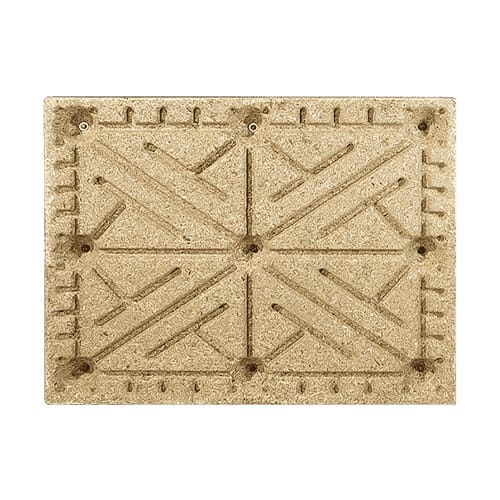
Xinyi’s double-deck square-grid pallet series uses molded upper and lower structural features for warehouse, logistics, manufacturing, and material-handling applications.
The appropriate pallet for transport should ultimately be selected according to cargo contact points, handling frequency, support conditions, and equipment requirements rather than deck style alone.
Pallet Dimensions Influence Transport Efficiency
Pallet transport efficiency starts with a footprint that matches the cargo reasonably well.
A pallet that is too small can allow products to extend beyond its edges. Overhang reduces direct support beneath packaging and exposes products to greater contact with other loads or handling equipment.
A pallet that is unnecessarily large creates a different problem. Unused deck area still occupies storage and transport space, even though it provides no additional product support.
The best pallet dimensions normally balance product coverage and space utilization.
The final packaged product should be measured rather than the unpackaged item. Cartons, wrapping, protective packaging, containers, and other materials can change the footprint significantly.
Load arrangement is also worth reviewing. Rotating cartons or changing the number of units per layer may improve pallet utilization without requiring a different pallet dimension.
For industrial pallet transport, size selection should also account for forklifts, racks, conveyors, stacking arrangements, and storage locations. A footprint that fits the product but conflicts with warehouse equipment does not provide an efficient solution.
How Forklift Entry Affects Pallet Transport
Forklift handling is one of the most frequent sources of interaction between a pallet and its surrounding equipment.
Entry openings need sufficient width and height so that operators can insert forks without repeatedly contacting supporting legs, runners, grids, or deck sections.
A pallet may technically accept the forklift blades but still provide inadequate operational clearance. When this happens repeatedly, contact around the entry areas can create unnecessary wear or damage.
Fork spacing should therefore be considered together with pallet geometry.
Two-way entry can work effectively where pallet orientation remains controlled. Four-way entry can provide more flexibility when pallets need to be approached from different directions during warehouse movement or loading.
The preferred configuration depends on the actual workflow. A more flexible entry design is not automatically better if the structure does not match the required load or handling system.
Pallet transport performance improves when operators can approach, lift, position, and release the load without unnecessary repositioning or contact.
Load Stability During Movement
A pallet may be structurally adequate while the cargo above it remains unstable.
Reliable pallet transport therefore depends on the relationship between pallet structure and load configuration.
A high or uneven load can respond more strongly to acceleration and directional changes. Loose cartons can shift, while irregular equipment may create an off-center center of gravity.
Packaging and load-restraint methods should help maintain the intended arrangement during normal handling. Pallet dimensions should also support the product footprint so that the load does not rely on unsupported edges.
Stacked carton patterns should be assessed for stability as well as deck utilization. A layout that places more cartons on a pallet is not necessarily better if it creates poor support or an unstable unit load.
The objective is consistent movement rather than maximum use of every available centimeter of deck area.
Comparing Pallet Transport Requirements
Different operating conditions create different priorities for the pallet.
| Pallet Transport Condition | Main Factor | What Should Be Evaluated | Common Error |
|---|---|---|---|
| Evenly distributed cartons | Deck support | Product coverage and load pattern | Selecting only by total weight |
| Heavy machinery | Concentrated loading | Contact points and local reinforcement | Assuming capacity is evenly available |
| Frequent forklift handling | Dynamic performance | Entry clearance and structural rigidity | Using only static load information |
| Rack storage | Unsupported span | Beam positions and pallet orientation | Treating floor and rack support equally |
| Conveyor transport | Bottom structure | Contact surfaces and dimensional consistency | Checking only external dimensions |
| Stacked loads | Stability and compression | Load alignment and supporting areas | Ignoring upper-load transfer |
| Long transport cycles | Repeat handling | Structure, load restraint and consistency | Evaluating only initial loading |
| Automated handling | Repeatable geometry | Dimensions, openings and orientation | Accepting excessive dimensional variation |
| Empty pallet movement | Storage efficiency | Weight, stacking and nesting | Considering only loaded pallets |
The table highlights an important point: pallet transport is a combination of structural support and operational compatibility. A pallet that performs well in one environment may require further evaluation before being used in another.
Pallet Transport in Warehouse Operations
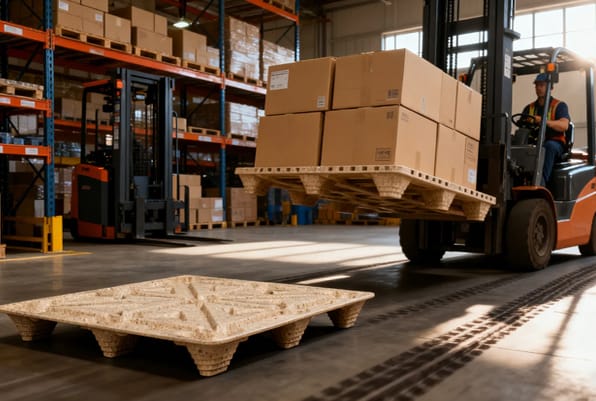
Warehouses are not simply places where loaded pallets remain stationary. A pallet may be received, moved to staging, placed in storage, retrieved, transferred to production, returned to storage, and moved again before leaving the facility.
The number of handling events can therefore be significant.
Repeated pallet transport makes fork-entry design, structural consistency, and dimensional accuracy increasingly important. Small handling problems that seem insignificant once can become operational issues when repeated throughout the working cycle.
Floor storage usually provides broad pallet support. Block stacking adds compression from loaded units above. Rack storage changes support again because loads may be carried primarily by beams.
Warehouses using several storage methods should ensure that the pallet structure works with each one rather than selecting only for the most convenient condition.
Pallet Transport on Conveyors
Conveyor systems introduce requirements that are easy to overlook when a pallet has been designed mainly for forklifts.
The bottom structure must provide appropriate contact with rollers, chains, or other conveying components. Large unsupported gaps or unsuitable leg positions can influence movement across the equipment.
Direction of travel matters as well. A pallet may interact differently with a conveyor when moving lengthwise versus widthwise.
Transfer points between conveyor sections can temporarily change the amount of lower support. A sufficiently rigid and dimensionally consistent pallet is more likely to move predictably through these transitions.
For applications involving both forklift and conveyor pallet transport, both handling systems should be included in the specification from the beginning.
Automation Makes Dimensional Consistency More Important
Automated warehouse systems have increased the importance of pallet repeatability.
A human operator can compensate for small dimensional variations or imperfect positioning. Automated equipment usually expects the pallet to arrive within defined dimensional limits.
Overall length, width, height, fork openings, supporting-leg locations, and lower structural geometry can all become relevant.
Manufacturing consistency therefore becomes more than a factory quality concern. It affects how the pallet interacts with equipment throughout the logistics system.
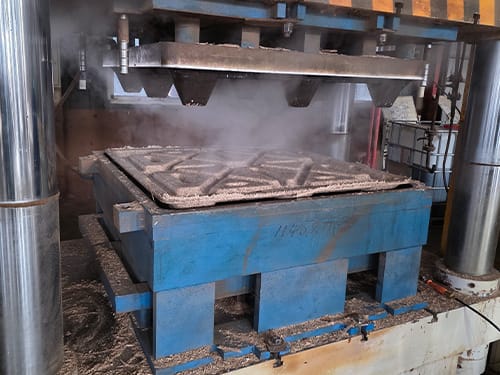
Molded pallet production can provide repeatable structural geometry when material preparation, molding conditions, and quality control are managed consistently. Traditional assembled pallets also require suitable control over components, dimensions, joints, and assembly.
Whichever construction method is used, predictable pallet geometry supports more reliable automated transport.
How Material Influences Pallet Transport
Several materials can be used for pallet transport, including traditional timber, molded wood fiber, plastic, metal, and other engineered materials.
Traditional wooden pallets can be produced in many structures and dimensions. Their performance is influenced by lumber condition, board dimensions, runner configuration, fasteners, joints, and manufacturing consistency.
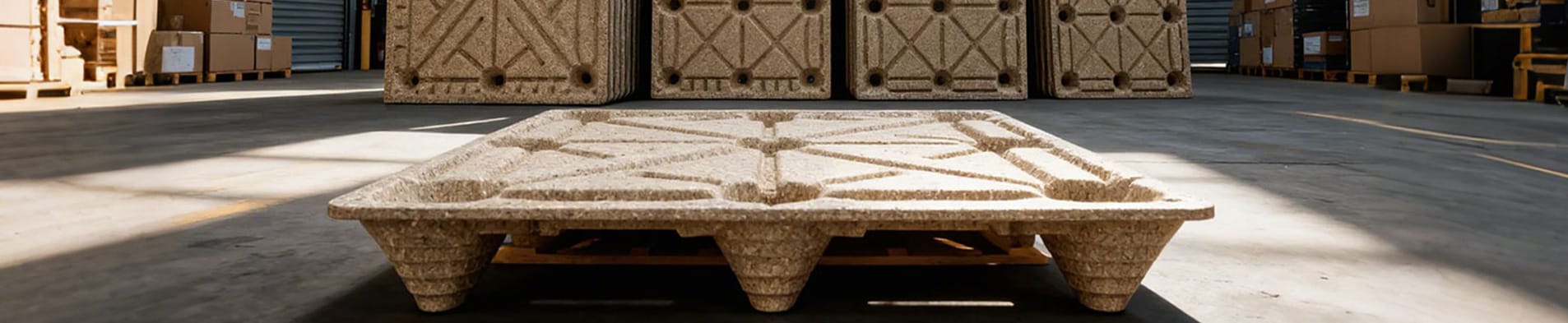
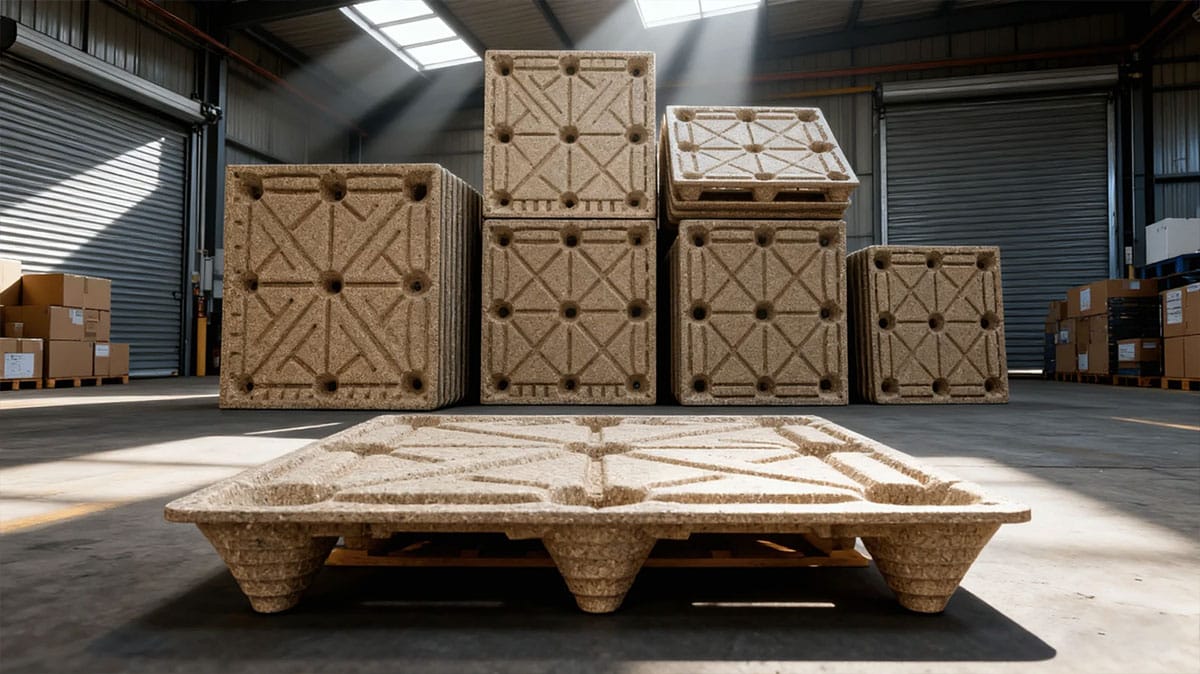
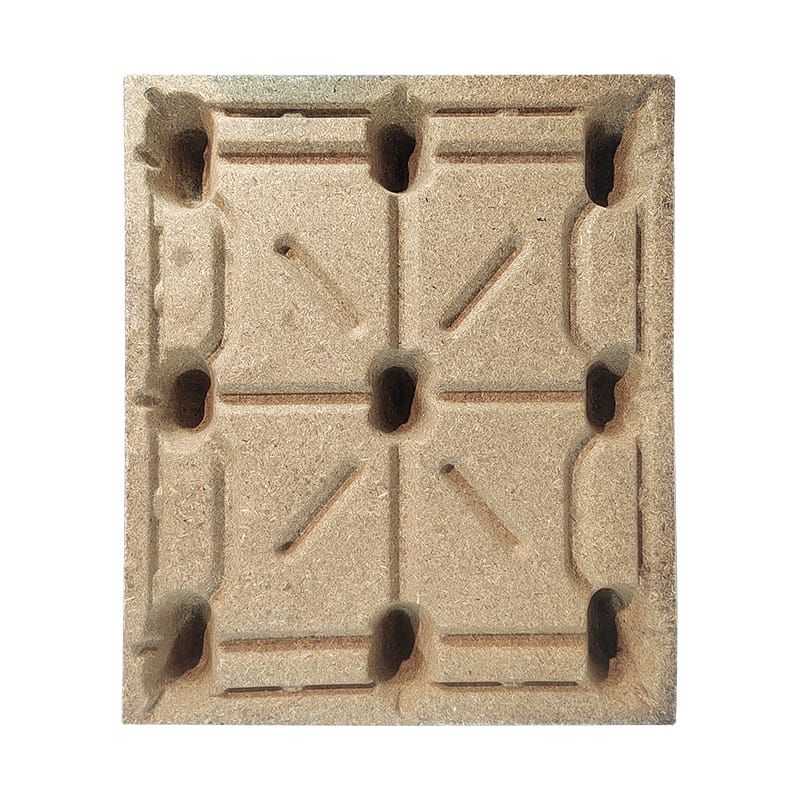
Molded wood pallets use processed fibrous material formed into an integrated structure. The deck, ribs, legs, and other features can be incorporated into the molded geometry, which may support repeatable dimensions and different nesting configurations.
Plastic and other materials may be suitable where particular environmental, cleaning, moisture, or circulation requirements apply.
The useful question is not which material is universally best for pallet transport. The better question is which pallet structure and material combination matches the load, handling equipment, storage method, environment, and intended operating cycle.
Why Pallet Weight Also Matters
Pallet tare weight becomes part of every loaded movement.
Forklifts lift the pallet as well as the cargo. Conveyors support both. Storage systems carry the combined unit load.
This does not mean that the lightest possible pallet should always be selected. Reducing material without considering structural requirements can create other problems.
A more useful goal is efficient structural design.
Material should contribute to useful load-bearing areas, fork-entry strength, deck rigidity, and supporting geometry rather than being added simply to increase pallet mass.
In large logistics operations, controlling unnecessary pallet weight can also make repeated handling more efficient.
Empty Pallet Transport and Storage
Pallet transport does not always involve loaded units.
Empty pallets also need to be stored, staged, transferred, and sometimes moved between production or warehouse areas.
Stackable designs allow empty pallets to be stored directly above one another. Some molded structures can nest, allowing supporting elements from one pallet to fit partially into another.
Nesting can reduce the volume occupied by empty pallets, which can be useful where large quantities accumulate in staging or storage areas.
The existing Xinyi guide to shipping wood pallets also discusses pallet characteristics relevant to shipping and logistics operations, including molded wood structures designed for repeated material handling.
Empty-pallet efficiency should not override loaded performance, but it is worth considering as part of the complete pallet transport cycle.
Environmental Conditions During Pallet Transport
Pallets may move through different storage and transport environments during their working life.
Conditions can include changes in humidity, enclosed storage, temporary staging, long loaded periods, and temperature variation.
For wood-based pallets, material preparation and manufacturing method can influence dimensional behavior. Traditional wood structures and processed molded wood structures should therefore be evaluated according to their actual production characteristics rather than being grouped together solely because both involve wood-based materials.
Surface condition also matters. Broken areas, protruding components, loose material, or significant deformation can interfere with packaging and material handling.
The pallet specification should reflect the intended operating environment when exposure conditions are known in advance.
When Customization Can Improve Pallet Transport
Standard pallet designs work efficiently when they match the cargo and equipment. Customization becomes useful when a recurring mismatch creates handling or structural problems.
A large piece of industrial equipment may require reinforcement beneath several concentrated support points. A repetitive carton arrangement may not fit an existing footprint efficiently. A conveyor system may require a specific lower support configuration.
Depending on the manufacturing method, customization can involve pallet dimensions, deck geometry, reinforcement locations, supporting legs, fork openings, or bottom structure.
The best customization projects begin with a clearly defined operational problem.
Changing a pallet simply to make it different adds little value. Adjusting it to improve load support, warehouse utilization, forklift access, or equipment compatibility can provide a more practical result.
What Information Should Be Defined Before Pallet Transport Begins?
Reliable pallet transport starts before the load is moved.
The cargo specification should identify the maximum loaded weight, final packaged footprint, load height, major contact points, and distribution across the deck.
Handling conditions should also be documented. Forklift type, fork dimensions, entry direction, expected handling frequency, and conveyor or automated-system requirements can all influence the pallet design.
Storage details matter as well. A pallet intended for rack storage may require different structural considerations from one that remains fully supported on a floor.
For repeated operations, consistent load placement is particularly valuable. When the same product is always positioned differently, the stresses acting on the pallet can also change.
A defined loading method improves the repeatability of the complete pallet transport process.
Common Pallet Transport Mistakes
A frequent mistake is using a static pallet rating to represent all handling conditions. Moving and racking create different support patterns, so their requirements should be considered separately.
Another problem is focusing on total cargo weight while ignoring load distribution. Concentrated industrial products can require additional structural support even when total weight remains within the nominal pallet capability.
Oversized and undersized pallets can both reduce efficiency. A small footprint may allow cargo overhang, while a large footprint wastes storage and transport space.
Forklift compatibility is also sometimes considered too late. Poor entry clearance can create repeated impacts and unnecessary handling adjustments.
Finally, companies may evaluate the pallet and packaging separately. Pallet transport is more predictable when cargo arrangement, load restraint, and pallet dimensions are planned together.
A Practical Pallet Transport Checklist
Before a loaded pallet enters regular handling, confirm that the cargo fits within the intended footprint and that major weight concentrations are properly supported.
Check that the pallet structure is suitable for floor storage, forklift handling, stacking, racking, conveyors, or other conditions that will occur during use.
Fork openings should provide practical clearance for the equipment, while pallet dimensions should fit surrounding warehouse and storage systems.
For repetitive transport, confirm that pallet dimensions and structural features remain consistent enough for the equipment involved. Automated systems may require tighter repeatability than manual handling.
Also review how empty pallets will be stored and moved. Pallet tare weight, stacking, and nesting can influence warehouse efficiency even though they do not directly affect the loaded product.
A complete review helps prevent a pallet from being optimized for one stage of the operation while creating difficulties somewhere else.
Conclusion
Effective pallet transport depends on much more than moving a load from one location to another.
The pallet needs to support the product while stationary and while moving, fit handling equipment, maintain useful structural rigidity, and remain compatible with warehouse, rack, conveyor, and storage systems.
The process should begin with the cargo. Total weight, load distribution, product footprint, contact points, and center of gravity provide the foundation for selecting an appropriate pallet.
Dimensions, material, deck structure, fork entry, manufacturing consistency, and pallet weight can then be evaluated around those requirements.
A strong pallet can still perform poorly if it does not fit the cargo or equipment. A lightweight pallet can perform effectively when its structural geometry matches the application. A common pallet size can still be inefficient when it creates overhang or wastes space.
The most reliable pallet transport systems are built around compatibility and repeatability. When the pallet, load, handling equipment, and storage environment are considered together, industrial movement becomes more stable, predictable, and efficient.
FAQ
What is pallet transport?
Pallet transport is the movement of palletized goods through warehouses, production areas, storage systems, conveyors, and distribution operations. Reliable transport depends on pallet strength, cargo stability, dimensions, load distribution, forklift compatibility, and appropriate support conditions.
How do I make pallet transport more stable?
Start with a pallet that fits the product footprint and supports the main load points. Keep cargo weight distributed as evenly as practical, maintain a stable center of gravity, use appropriate load restraint, and confirm that fork openings, stacking conditions, and storage systems match the pallet design.
Does pallet transport require a specific pallet load capacity?
Required capacity depends on the unit-load weight and how the pallet is supported. Floor storage, forklift movement, stacking, and rack storage create different structural conditions. Static capacity alone should therefore not be used to represent every stage of pallet transport.
Why do pallet dimensions matter during transport?
Pallet dimensions affect cargo support, overhang, forklift handling, warehouse space, stacking, conveyors, and storage compatibility. A pallet should be large enough to support the product without creating unnecessary unused deck area that reduces logistics and warehouse efficiency.
Are molded wood pallets suitable for pallet transport?
Molded wood pallets can be suitable when their dimensions, structural geometry, load capability, and fork-entry configuration match the application. Integrated ribs, legs, and molded support areas can also provide repeatable geometry for warehouse and industrial transport operations.